This week, we've reached 400ppm of CO2 in the atmosphere for the first time in about 4 million years. In other words, efforts so far to reduce carbon emissions are not enough. Much more needs to be done just to stop emissions rising. What is really needed is to get back to safe levels (350ppm would be a good start).
So what did the world look like the last time there was 400ppm of CO2 in the atmosphere? Click here.
And here's a short and to-the-point slideshow which illustrates where we are at.
Are we destined over the next generation or two to see 40m sea-level rise, a large increase in pests and diseases as temperature zones shift, challenging weather conditions, impacts on our economies and food supplies? To some extent, we are seeing these things now. But a massive and widespread effort to reduce emissions would minimise the chances of seeing such dramatic changes in the future.
Ironically, we have the capacity to make huge changes straight away with hi-tech and low-tech solutions (including options as humble as changing behaviours). What is urgently required politically, in communities and individually is the will. So simple and yet so difficult.
Showing posts with label Climate Change. Show all posts
Showing posts with label Climate Change. Show all posts
Sunday, May 12, 2013


Thursday, September 08, 2011
24 Hours of Reality
For an update on climate change and how it is affecting us already.....
Al Gore’s follow up to An Inconvenient Truth is here. "24 Hours of Reality" is a global event to get people all over the world watching the live transmission, together.
Book a night in or watch it with friends - the date for your diary is 15th September at 7pm
Click here to watch it: http://www.globalactionplan.org.uk/24-hours-reality-watch-it-live
For all sorts of other inspiring stuff, have a look at the rest of Global Action Plan's website. You may have heard of the EcoTeams programme that they have run across Nottinghamshire, but they do a lot more besides: http://www.globalactionplan.org.uk/
Al Gore’s follow up to An Inconvenient Truth is here. "24 Hours of Reality" is a global event to get people all over the world watching the live transmission, together.
Book a night in or watch it with friends - the date for your diary is 15th September at 7pm
Click here to watch it: http://www.globalactionplan.org.uk/24-hours-reality-watch-it-live
For all sorts of other inspiring stuff, have a look at the rest of Global Action Plan's website. You may have heard of the EcoTeams programme that they have run across Nottinghamshire, but they do a lot more besides: http://www.globalactionplan.org.uk/
Wednesday, January 12, 2011
Ways to Save Water in the home
Monday 17th January 2011
7pm for refreshments, prompt start at 7.30pm
SNC Training, South Notts College
Mere Way, Ruddington Fields Business Park, NG11 6JZ
The fourth in a series of free events.
Including:
It’s always raining – surely we have plenty of water?
Would a water meter save me money?
Low flow taps, showers and low flush loos
Saving hot water
Greywater and rainwater systems
Water diversion
What’s eco and what’s not? What saves money and what doesn’t?
Talks by: Members of the Eco House Group and others who have saved water in their own homes by different methods, plus a chance to ask your questions.
On a water meter already? Can you bring along your average monthly water use in cubic metres or in litres, and what that costs? Just a bit of fun – we want to compare the numbers with standard water rates, not to embarrass anyone.
Please email info@wbecohouses.co.uk if you are likely to be attending.
Directions: Follow Mere Way through Ruddington Fields Business Park. Pass the first SNC building on the left, and take the next turning to the second SNC Training building. It has a distinctive suspended curved wall with car parking beneath it. Park here or on the roadside.
Buses to Ruddington village: Ruddington Connection (Trent Barton) & No. 10 (Nott City Transport)
The Eco House Group is a project inspired by Transition West Bridgford
7pm for refreshments, prompt start at 7.30pm
SNC Training, South Notts College
Mere Way, Ruddington Fields Business Park, NG11 6JZ
The fourth in a series of free events.
Including:
It’s always raining – surely we have plenty of water?
Would a water meter save me money?
Low flow taps, showers and low flush loos
Saving hot water
Greywater and rainwater systems
Water diversion
What’s eco and what’s not? What saves money and what doesn’t?
Talks by: Members of the Eco House Group and others who have saved water in their own homes by different methods, plus a chance to ask your questions.
On a water meter already? Can you bring along your average monthly water use in cubic metres or in litres, and what that costs? Just a bit of fun – we want to compare the numbers with standard water rates, not to embarrass anyone.
Please email info@wbecohouses.co.uk if you are likely to be attending.
Directions: Follow Mere Way through Ruddington Fields Business Park. Pass the first SNC building on the left, and take the next turning to the second SNC Training building. It has a distinctive suspended curved wall with car parking beneath it. Park here or on the roadside.
Buses to Ruddington village: Ruddington Connection (Trent Barton) & No. 10 (Nott City Transport)
The Eco House Group is a project inspired by Transition West Bridgford
Wednesday, January 05, 2011
Comparisons of three winters 08, 09 and 10
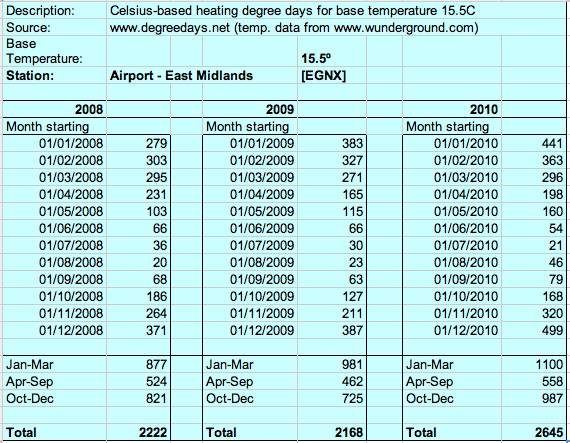
Degree Days are a good way to assess the thermal performance of the month and the year as they record the number of degrees during how many days that heating systems were required to bring the building up to a desired temperature.
We normally use 15.5º in degree day calculations on the basis that incidental gains are enough to make the temperature comfortable. This is a bit approximate, as in the recent winter, there has been little sun through windows, and with energy efficient lighting, appliances and cooking, the incidental gains are less than hoped for. Incidental gains in equinox times are perfect, but in December and January? Not much!
The figures above show the degree days on a month by month basis for Nottingham, for the last three years. 2008 was a very typical year, whereas 2009 was somewhat milder. The year of 2010 was truly more severe by 20%, with the very cold spring and the very cold winter occurring within the same calendar year.
I have split the year into 3 blocks which equate to the times I use for metering, Jan-Mar, Apr-Sep and Oct-Dec. As these figures are monthly, I can relate these to the consumption of the heating system, and generate a sort of index of performance.
The figures above show the degree days on a month by month basis for Nottingham, for the last three years. 2008 was a very typical year, whereas 2009 was somewhat milder. The year of 2010 was truly more severe by 20%, with the very cold spring and the very cold winter occurring within the same calendar year.

What does this mean graphically?
Well, it shows that there has been a cooling winter trend annually. Do not be deceived into thinking that this disproves 'global warming' because climate change globally is about change, AKA chaos. It does not result in every place getting warmer. Britain could get cooler if the Gulf Stream is affected by melting polar ice.
If you want more explanation about Degree Days, you are welcome to email DNC
Post script: The first day in 2010 that had evening temperature higher than 10.0º was 17 March! We have having a succession of days like that in mid January 2011.
Wednesday, September 01, 2010
Bjorn Lomborg turns at last
31 Aug: a few years ago, the Climate Change debate was countered by the energetic influence of Bjorn Lomborg, a Danish academic who gave cheer to all the deniers, such as Nigel Lawson. In more recent times I read that he now believed in Climate Change, but now felt that it was too late and too expensive to do anything about it (having no remorse it seems for his part in having things go beyond the tipping point).
In today's Guardian, the front page story leads with his total U-Turn, in which he now agrees that it is the most important thing to make a major international investment in - countering Climate Change.
Subscribe to:
Posts (Atom)