The eighth home taking part in this year's spring time Open Homes event is a 1940's end terrace in Holwell near Melton Mowbray.
This home has had to be withdrawn
There are others with some similar features such as
Greenstone in East Leake.
So far, the owners have installed:
- low energy lighting
- PV panels on the roof linked to a system that diverts spare electricity from the roof to heat water.
They installed the PV panels in December 2014 so know how the system will run through the winter (the worst months for PV) and are no doubt hoping for a sunny summer!
Showing posts with label Electricity. Show all posts
Showing posts with label Electricity. Show all posts
Monday, March 23, 2015


Thursday, November 22, 2012
It's windy out there!
A piece of news that I heard via the AECB (Sustainable Builders Association) and CAT (Centre for Alternative Technology):
In the early hours of this morning (22nd November 2012), electricity production from wind power actually exceeded electricity from gas! Between 3:30am and 5:30am, UK wind turbines produced around 4.2GW whereas gas power stations contributed a bit less than 4GW.
By the way - if you are thinking of checking your draught-proofing around the house, then a windy day is a great time to do it. Hold your hand near to doors frames, window frames, skirting boards, chimneys and so on to work out where cold air is leaking in and warm air is leaking out.
If you have any specific questions about draught-proofing, just email wbecohouses.co.uk and the answer might get posted on this blog.
In the early hours of this morning (22nd November 2012), electricity production from wind power actually exceeded electricity from gas! Between 3:30am and 5:30am, UK wind turbines produced around 4.2GW whereas gas power stations contributed a bit less than 4GW.
By the way - if you are thinking of checking your draught-proofing around the house, then a windy day is a great time to do it. Hold your hand near to doors frames, window frames, skirting boards, chimneys and so on to work out where cold air is leaking in and warm air is leaking out.
If you have any specific questions about draught-proofing, just email wbecohouses.co.uk and the answer might get posted on this blog.
Monday, October 10, 2011
Eco Houses Under Construction - Event 5
The 5th event in the series will take place on Saturday 12th November, 2-5pm.
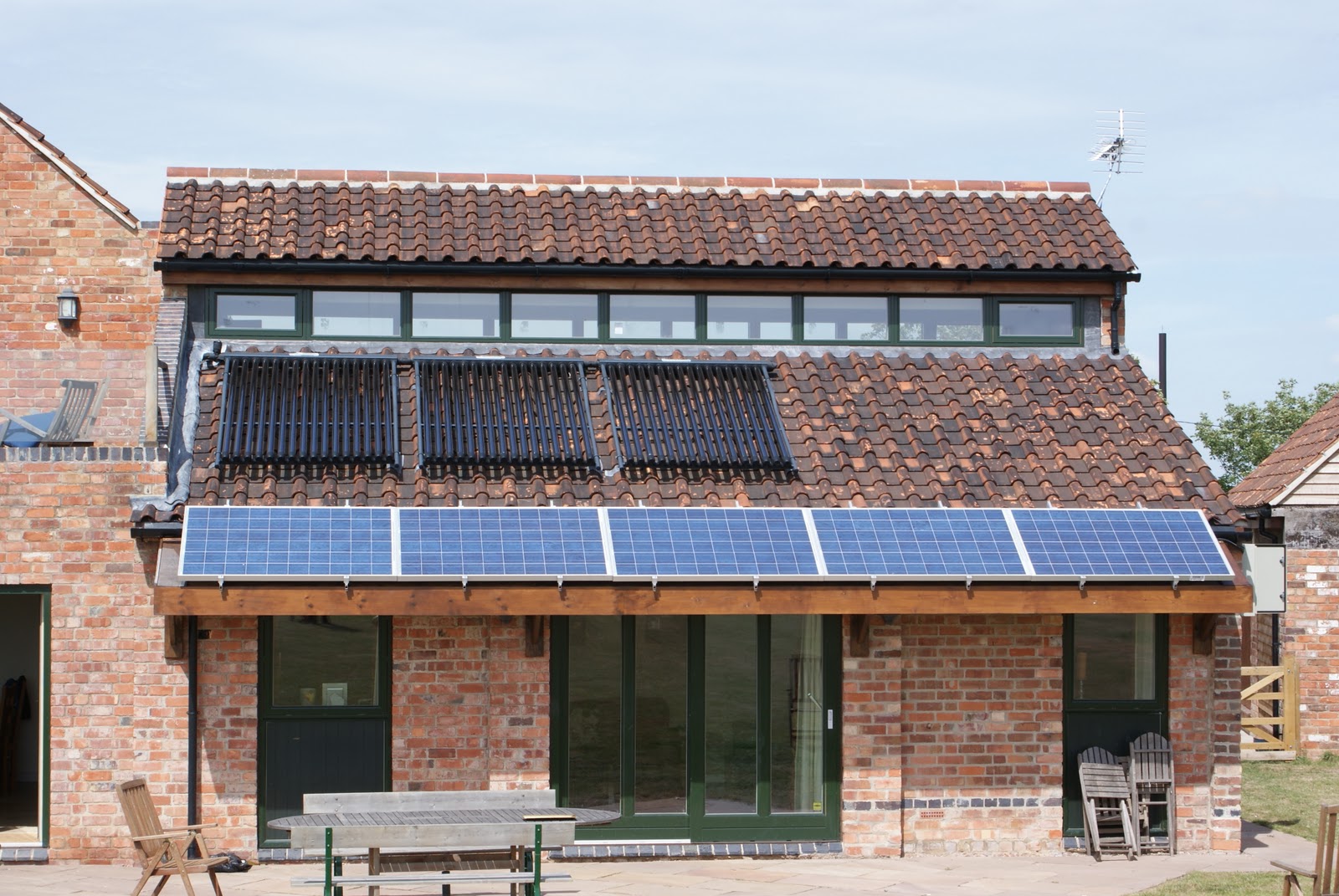
This is a rare opportunity to visit the UK's first Zero Carbon Barn Conversion, just down the road in East Leake. The developer (and owner) of this home is David Hill, who previously developed the UK's first Code 6 new build Zero Carbon homes in Upton, Northampton. He is now director of Carbon Legacy Ltd.
Although not still "under construction", this house has the advantage of 3 years' energy data post completion, showing that the approach taken has worked.


(For anyone who attended the series of Eco House Seminars which we ran this time last year, you may remember that David presented a talk on low energy refurbishment, and also contributed to the seminar on renewable energy for homes.)
For more information or to book your place on this free event, email Tina on info@wbecohouses.co.uk
Here is David's summary of the house:
· Super insulated 9” solid brick walls
· Factory made Insulated roof panels (SIPS)
· Super insulated floor slab with wet under floor heating (ground and first floor)
· Extensive use of thermal mass in floors, internal walls and ceiling
· Whole house ventilation with heat recovery 90% efficiency
· Triple glazed timber windows with aluminium outer skin (Rationel)
· Draft lobby with highly insulated doors (Rationel)
· Air tight construction with measured value of 2.3m3/m2@50Pa pressure
· Thermal store fed by oversized Solar Hot water panels and heat pump for space heating and domestic hot water
· Ground sourced heat Pump (GSHP) providing space heating and some of the domestic hot water
· Experimental Sunbox providing Earth charging energy from solar and ambient air to improve the efficiency of the GSHP
· Rain water recycling from underground tank to provide water for toilet flushing and garden irrigation
· Presence and daylight sensor light control in common areas of the house
· 100% low energy lighting and low energy appliances
· Planning permission and foundation pad for a 10-15kw VAWT wind turbine for when I find one that works!
· Reserve wood pellet 5kw stove in case of power failure
· It has met its target energy consumption with 3 years’ worth of all power consumption (electricity) 10,500kwh/year
· If we had the 10kw wind turbine (long story) or when we install the 10kw or bigger Solar PV installation then the house will generate as much or more power than it consumes.
· It may also provide free electricity to charge 2 electric cars the first of which is due to arrive in 2012
· The family loves it because it is comfortable and pleasant to live in all year round
This is a rare opportunity to visit the UK's first Zero Carbon Barn Conversion, just down the road in East Leake. The developer (and owner) of this home is David Hill, who previously developed the UK's first Code 6 new build Zero Carbon homes in Upton, Northampton. He is now director of Carbon Legacy Ltd.
Although not still "under construction", this house has the advantage of 3 years' energy data post completion, showing that the approach taken has worked.


(For anyone who attended the series of Eco House Seminars which we ran this time last year, you may remember that David presented a talk on low energy refurbishment, and also contributed to the seminar on renewable energy for homes.)
For more information or to book your place on this free event, email Tina on info@wbecohouses.co.uk
Here is David's summary of the house:
· Super insulated 9” solid brick walls
· Factory made Insulated roof panels (SIPS)
· Super insulated floor slab with wet under floor heating (ground and first floor)
· Extensive use of thermal mass in floors, internal walls and ceiling
· Whole house ventilation with heat recovery 90% efficiency
· Triple glazed timber windows with aluminium outer skin (Rationel)
· Draft lobby with highly insulated doors (Rationel)
· Air tight construction with measured value of 2.3m3/m2@50Pa pressure
· Thermal store fed by oversized Solar Hot water panels and heat pump for space heating and domestic hot water
· 10kwp Solar PV system installed in December which should make us carbon neutral in energy use. Half of the system also feeds a new type of inverter (Nedap Powerrouter). This will do 5 important tasks: Send power to the house as it is required, when the house does not need the power divert it to a large battery store, in the evening when the house is calling for electricity turn the battery power into AC and send it to the house, during the day if the house does not need power and the batteries are fully charged then export power to the grid, should the Mains Grid supply fail then the unit will continue to feed converted power from the batteries into the house independently.
· Ground sourced heat Pump (GSHP) providing space heating and some of the domestic hot water
· Experimental Sunbox providing Earth charging energy from solar and ambient air to improve the efficiency of the GSHP
· Rain water recycling from underground tank to provide water for toilet flushing and garden irrigation
· Presence and daylight sensor light control in common areas of the house
· 100% low energy lighting and low energy appliances
· Planning permission and foundation pad for a 10-15kw VAWT wind turbine for when I find one that works!
· Reserve wood pellet 5kw stove in case of power failure
Interesting
facts/results:
· It works!· It has met its target energy consumption with 3 years’ worth of all power consumption (electricity) 10,500kwh/year
· If we had the 10kw wind turbine (long story) or when we install the 10kw or bigger Solar PV installation then the house will generate as much or more power than it consumes.
· It may also provide free electricity to charge 2 electric cars the first of which is due to arrive in 2012
· The family loves it because it is comfortable and pleasant to live in all year round
Thursday, September 01, 2011
Things you need to know about Insulation and Electrics
With many people thinking about insulating the loft, under the floor and so on, it is perhaps a very good time to draw to your attention to the issues around electric cables.
If, like me, you start to glaze over at the first mention of electricity, don’t worry – there are some very basic facts you need to know, and from there on in you just need to ask a competent electrician.
First thing – don’t just leave your cables going through, within or adjacent to insulation, close to underfloor heating, and so on. They may get too hot and become a fire risk. That’s not to say you can’t put your cables there, it just means….
Second thing - a competent electrician can do the calculations you need, to check what size cable is needed for the particular situation, in case it needs increasing to dissipate the necessary amount of heat.
In addition to your electric cables, watch out for downlighters, which also need to dissipate heat. Some electrical installers just pull your loft insulation out of the way, solving one problem but creating another. (Most downlighters should have fire hoods over them as well, while we’re on the subject.) Again, the solution is a good electrician (with something called a Part P qualification and the relevant experience).
And while we’re here, a reminder that the Wiring Regulations call for the installer of any new circuit to affix a label to the Consumer Unit (old version is a Fuse Box) which indicates when the next inspection is due. If you don’t have one of these, chances are you have not had your wiring checked in 10 years, which is definitely not a good idea.
The process is called a Periodic Inspection and Testing Report (PIR), and there has just been an Amendment to the 17th Edition of the Wiring Regulations released, coming into force on January 1st 2012, when it will then be called the Electrical Installation Condition Report (EICR). Unless you have been advised differently (because an inspection has found deterioration in your installation), the Wiring Regulations require there to be a PIR done every 10 years, or on change of ownership.
This information has been provided by Helen Hill, who is a member of the Eco House Group, and a qualified electrician.
If you are looking to find a competent, qualified electrician, Helen makes the following suggestions:
1) Trustmark has a website where you can look for a local tradesperson. It is the government’s approved operator scheme which ensures standards, processes and complaints procedures are maintained. Info at http://www.trustmark.org.uk/key-benefits .
2) The equivalent to Trustmark, if a company is installing renewable energy, is the Renewable Energy Assurance Ltd (REAL) scheme, info athttp://www.realassurance.org.uk/ , and a company does not need to be in both Trustmark and REAL if they do both types of installations. REAL also has a database where you can look up companies to see if they are members of the scheme. They, and Trustmark, also have Deposit protection schemes.
3) Qualifications – some people calling themselves electricians have just done a very short course (which can be as short as 5 days, costing £795) to get the Part P qualification, usually for domestic installations only. For example, kitchen fitters can get a Part P limited scope qualification this way, so they should not do other types of installation. On the other hand, some people spend two years at college getting City & Guilds Electrotechnical qualifications, followed by further qualifications including the C&G 2391 Inspection & Testing. There should be someone in each company who has sufficient knowledge and experience to pass the 2391 in my view, as it is supposed to assess the skills and knowledge necessary to fill in the Electrical Installation Certificate correctly.
4) The Part P qualification means that the electrical company should work to the current Edition of the Wiring Regulations (17th , and an amendment will take effect on Jan 1st 2012), they should issue Electrical Installation Certificates or Minor Works Certificates (needed when selling your house), and they should notify the Local Authority Building Control that work has been done to the standards set out in Part P of the Building Regulations, if the work done is notifiable (such as a new circuit). If the work is done “cash-in-hand” they are working the black market, avoiding VAT administration, and you probably have no guarantees of workmanship, warranties, or safety, as they will not want records of transactions.
5) Trade Associations – most electrical contractors will be members of a Trade Association, so that they can notify Building Control directly through their Trade Association. This is easier and cheaper, as going it alone costs about £150 per notification. Examples of electrical Trade Associations, in no particular order are NAPIT, NICEIC, ELECSA (with SELECT in Scotland) and so on. Another advantage of using one of their members is that they have Work Guarantee Schemes, should the company go out of business.
If, like me, you start to glaze over at the first mention of electricity, don’t worry – there are some very basic facts you need to know, and from there on in you just need to ask a competent electrician.
First thing – don’t just leave your cables going through, within or adjacent to insulation, close to underfloor heating, and so on. They may get too hot and become a fire risk. That’s not to say you can’t put your cables there, it just means….
Second thing - a competent electrician can do the calculations you need, to check what size cable is needed for the particular situation, in case it needs increasing to dissipate the necessary amount of heat.
In addition to your electric cables, watch out for downlighters, which also need to dissipate heat. Some electrical installers just pull your loft insulation out of the way, solving one problem but creating another. (Most downlighters should have fire hoods over them as well, while we’re on the subject.) Again, the solution is a good electrician (with something called a Part P qualification and the relevant experience).
And while we’re here, a reminder that the Wiring Regulations call for the installer of any new circuit to affix a label to the Consumer Unit (old version is a Fuse Box) which indicates when the next inspection is due. If you don’t have one of these, chances are you have not had your wiring checked in 10 years, which is definitely not a good idea.
The process is called a Periodic Inspection and Testing Report (PIR), and there has just been an Amendment to the 17th Edition of the Wiring Regulations released, coming into force on January 1st 2012, when it will then be called the Electrical Installation Condition Report (EICR). Unless you have been advised differently (because an inspection has found deterioration in your installation), the Wiring Regulations require there to be a PIR done every 10 years, or on change of ownership.
This information has been provided by Helen Hill, who is a member of the Eco House Group, and a qualified electrician.
If you are looking to find a competent, qualified electrician, Helen makes the following suggestions:
1) Trustmark has a website where you can look for a local tradesperson. It is the government’s approved operator scheme which ensures standards, processes and complaints procedures are maintained. Info at http://www.trustmark.org.uk/key-benefits .
2) The equivalent to Trustmark, if a company is installing renewable energy, is the Renewable Energy Assurance Ltd (REAL) scheme, info athttp://www.realassurance.org.uk/ , and a company does not need to be in both Trustmark and REAL if they do both types of installations. REAL also has a database where you can look up companies to see if they are members of the scheme. They, and Trustmark, also have Deposit protection schemes.
3) Qualifications – some people calling themselves electricians have just done a very short course (which can be as short as 5 days, costing £795) to get the Part P qualification, usually for domestic installations only. For example, kitchen fitters can get a Part P limited scope qualification this way, so they should not do other types of installation. On the other hand, some people spend two years at college getting City & Guilds Electrotechnical qualifications, followed by further qualifications including the C&G 2391 Inspection & Testing. There should be someone in each company who has sufficient knowledge and experience to pass the 2391 in my view, as it is supposed to assess the skills and knowledge necessary to fill in the Electrical Installation Certificate correctly.
4) The Part P qualification means that the electrical company should work to the current Edition of the Wiring Regulations (17th , and an amendment will take effect on Jan 1st 2012), they should issue Electrical Installation Certificates or Minor Works Certificates (needed when selling your house), and they should notify the Local Authority Building Control that work has been done to the standards set out in Part P of the Building Regulations, if the work done is notifiable (such as a new circuit). If the work is done “cash-in-hand” they are working the black market, avoiding VAT administration, and you probably have no guarantees of workmanship, warranties, or safety, as they will not want records of transactions.
5) Trade Associations – most electrical contractors will be members of a Trade Association, so that they can notify Building Control directly through their Trade Association. This is easier and cheaper, as going it alone costs about £150 per notification. Examples of electrical Trade Associations, in no particular order are NAPIT, NICEIC, ELECSA (with SELECT in Scotland) and so on. Another advantage of using one of their members is that they have Work Guarantee Schemes, should the company go out of business.
Friday, January 14, 2011
Where does your electricity come from?
 13 Jan '11: Electricity companies are obliged to reveal their sources of power, but not all of them are keen to make it too obvious. Ecotricity, for example make a big fuss about this, even in the choice of their name, yet they are using a proportion of Nuclear power, presumably because by some definition the lack of burning coal makes it green, somehow.
This website, electricityinfo.org is useful because it does show an up to date breakdown of the sources for each company. The only one that I can find that is 100% renewable based (Wind farms, home microgeneration etc) is Good Energy.
There is a click link from this site to a 'Green Energy selector' which compares tariffs from companies who have sizeable proportions of renewable energy as their course.
http://www.electricityinfo.org/suppliers.php List of Suppliers and their green component.
http://www.greenelectricity.org/ Another site that enables you to compare green tariffs and make the switch. Good Energy are more expensive than others, but they are the only 100% renewable.
Subscribe to:
Posts (Atom)