A piece of news that I heard via the AECB (Sustainable Builders Association) and CAT (Centre for Alternative Technology):
In the early hours of this morning (22nd November 2012), electricity production from wind power actually exceeded electricity from gas! Between 3:30am and 5:30am, UK wind turbines produced around 4.2GW whereas gas power stations contributed a bit less than 4GW.
By the way - if you are thinking of checking your draught-proofing around the house, then a windy day is a great time to do it. Hold your hand near to doors frames, window frames, skirting boards, chimneys and so on to work out where cold air is leaking in and warm air is leaking out.
If you have any specific questions about draught-proofing, just email wbecohouses.co.uk and the answer might get posted on this blog.
Showing posts with label Eco Tips. Show all posts
Showing posts with label Eco Tips. Show all posts
Thursday, November 22, 2012


Friday, June 22, 2012
Cheap ways to reduce heat loss through windows
Janet has just sent a photo of her newly-installed blinds. She installed them because she was concerned about heat rising behind the curtains. This way, even with the curtains open, a well-fitted blackout blind or thermal blind will reduce heat loss.
Alternatively, if the situation allows, why not double up on window coverings by combining curtains, blinds or shutters?
With a suitable window ledge or a small shelf below the curtains, heat from the back of the radiator goes into the room rather than up behind the curtains. This is even more effective if you put radiator panels behind the radiator to reduce loss of heat into the external wall.

For more ideas, have a look at the HOBBS report on this blog (2nd tab). You can download it for free, allowing you to click on the contents page to read one of the case studies or any other part of the report.
Alternatively, if the situation allows, why not double up on window coverings by combining curtains, blinds or shutters?
With a suitable window ledge or a small shelf below the curtains, heat from the back of the radiator goes into the room rather than up behind the curtains. This is even more effective if you put radiator panels behind the radiator to reduce loss of heat into the external wall.

For more ideas, have a look at the HOBBS report on this blog (2nd tab). You can download it for free, allowing you to click on the contents page to read one of the case studies or any other part of the report.
Monday, February 06, 2012
Homes Behaving Badly!

Our new project, Homes Behaving Badly (HOBBs), is now under-way.
For all the details, do have a look at the press release. (we are very proud of it!)
We are busy preparing for the free HOBBs events in March, and to make that as relevant as possible for people who are considering home energy improvements, we have created a questionnaire.
If you would like to tell us a bit about your house and your home energy priorities, click here to take part in the questionnaire. (It is entirely up to you whether you provide your name or contact details, or complete it anonymously.)
If your home is not a paragon of energy-efficiency and comfort, the HOBBs project could be right up your street!
Tina and the HOBBs team
Thursday, September 01, 2011
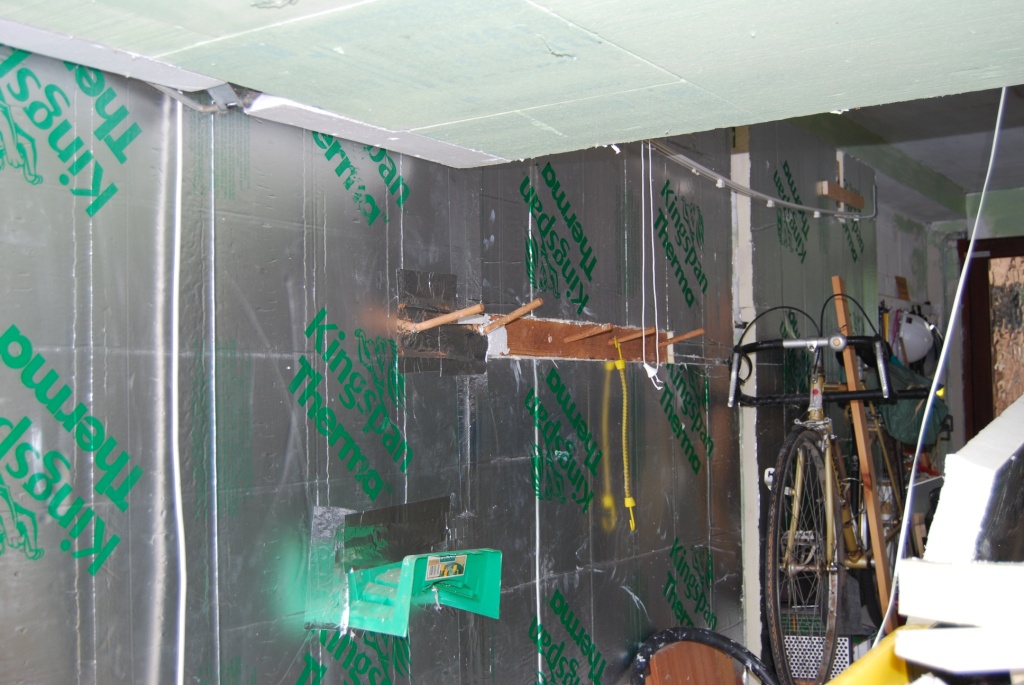
DIY insulation in action
If you are considering some DIY insulation, here is an update from Ian which may be of interest...
"The dining room was made from half the integral garage but there was no insulation in the new wall - just 165mm of blockwork. I spoke to one of the professionals at an Eco House Group seminar in 2010 and he advised insulating it. I bought some 1.2m x 2.4m x 50mm Kingspan foam boards from secondsandco and have put most of them up. I was going to use coving adhesive but Wickes only had 25Kg bags so I used dabs of plaster on the wall and aluminium tape round the edges. I had already lined the metal door with polystyrene to keep a bit of heat in the garage. Also there was a large gap at the bottom of the door so I put 25mm strip of 6mm plywood inside an old bike inner tube and bolted it to the edge of the door."

Thursday, May 12, 2011
The Eco House Group becomes a case study
The charity "Marches Energy Agency" has just sent out the following invitation to all who receive its newsletter, featuring our very own Eco House Group. If you like to know what other projects and events happen across the Midlands, do have a look at their website or sign up for their newsletter.
First Community Climate Action Case Study Now Online
Many of the people who receive monthly Community Climate Action e-newsletters are involved in inspiring projects to tackle climate change. So when we ran a survey earlier this year and lots of you said that you would like to see case studies of local projects which are tackling climate change, we jumped at the chance to tell some of your inspiring stories!
The first case study – of the EcoHouse Group project in West Bridgford – is now online and can be read here: www.everybodys-talking.org/communities-area/community-projects-case-studies/ecohouse-group.
We’re hoping this will the first of many case studies showcased on the website and that they will inspire further action to tackle climate change around Derbyshire and Nottinghamshire. If you have a project you’d like to share with others please email us brief details: ccan@mea.org.uk. Please include a telephone number if possible and we’ll be in touch.
The EcoHouse Group was organised by Transition West Bridgford. This weekend they are involved in two exciting events.
West Bridgford Summer Gathering
14th May, 10am-4pm
A celebration of sustainable and community living in West Bridgford with lots of stalls, food and entertainment : www.wbsummergathering.co.uk
Eco House Open Day
15th May
It was this event last year which kick-started the Eco House Group. People can sign up by attending the Summer Gathering.
Contact: info@wbecohouses.co.uk
First Community Climate Action Case Study Now Online
Many of the people who receive monthly Community Climate Action e-newsletters are involved in inspiring projects to tackle climate change. So when we ran a survey earlier this year and lots of you said that you would like to see case studies of local projects which are tackling climate change, we jumped at the chance to tell some of your inspiring stories!
The first case study – of the EcoHouse Group project in West Bridgford – is now online and can be read here: www.everybodys-talking.org/communities-area/community-projects-case-studies/ecohouse-group.
We’re hoping this will the first of many case studies showcased on the website and that they will inspire further action to tackle climate change around Derbyshire and Nottinghamshire. If you have a project you’d like to share with others please email us brief details: ccan@mea.org.uk. Please include a telephone number if possible and we’ll be in touch.
The EcoHouse Group was organised by Transition West Bridgford. This weekend they are involved in two exciting events.
West Bridgford Summer Gathering
14th May, 10am-4pm
A celebration of sustainable and community living in West Bridgford with lots of stalls, food and entertainment : www.wbsummergathering.co.uk
Eco House Open Day
15th May
It was this event last year which kick-started the Eco House Group. People can sign up by attending the Summer Gathering.
Contact: info@wbecohouses.co.uk
Wednesday, April 06, 2011
Make your own furniture!
You may have seen "John's Rustic Furniture" at the West Bridgford farmer's market (every 2nd and 4th Saturday in the month).
John makes all sorts of interesting pieces, and if you'd like to get skilled up yourself, he also runs workshops:
"Enjoy 2 days creating your own bentwood chair to take home. Made from coppiced willow and hazel using traditional methods. Join a small group at Yew Tree Cottage garden in the hidden village of Thrumpton. £195 for 2 days tuition, all materials and tools supplied, homemade cake, tea and refreshments throughout the day.
1st and 3rd weekends in the spring and summer months.
Contact John for further details: 0115 9830186, info@johnsrusticfurniture.co.uk
Or have a look at the website: www.johnsrusticfurniture.co.uk"
John makes all sorts of interesting pieces, and if you'd like to get skilled up yourself, he also runs workshops:
"Enjoy 2 days creating your own bentwood chair to take home. Made from coppiced willow and hazel using traditional methods. Join a small group at Yew Tree Cottage garden in the hidden village of Thrumpton. £195 for 2 days tuition, all materials and tools supplied, homemade cake, tea and refreshments throughout the day.
1st and 3rd weekends in the spring and summer months.
Contact John for further details: 0115 9830186, info@johnsrusticfurniture.co.uk
Or have a look at the website: www.johnsrusticfurniture.co.uk"
Tuesday, March 15, 2011
Left out in the cold.
After the very cold weather in November and December 2010, it is worth sharing a few thoughts that might help with being prepared for future cold winters.

I've recently heard about one person who insulated the loft. This, however, meant that the water tank and pipework in the loft were no longer warmed by the heat lost from the house. They froze in the cold weather and burst when the thaw came, doing thousands of pounds worth of damage.
In a similar fashion, gas boilers inside the house with a condensate pipe draining on the outside may suffer when the condensate in the pipe freezes. This pipe could be insulated or even drain internally so that freezing is no longer likely.
So as an addition to the mantra "insulate walls, floors and lofts", please add insulation to "pipework, tanks or other equipment" because these can often be left, quite literally "out in the cold".
Tanks in the loft should also be insulated, but in such a way that the loft insulation wraps up the side and over the top - leaving the bottom of the tank with an uninsulated surface to the house below - if the insulation is good enough it will keep the water at nearly room temperature - meaning you don't get a cold shock when you run the cold tap!

I've recently heard about one person who insulated the loft. This, however, meant that the water tank and pipework in the loft were no longer warmed by the heat lost from the house. They froze in the cold weather and burst when the thaw came, doing thousands of pounds worth of damage.
In a similar fashion, gas boilers inside the house with a condensate pipe draining on the outside may suffer when the condensate in the pipe freezes. This pipe could be insulated or even drain internally so that freezing is no longer likely.
So as an addition to the mantra "insulate walls, floors and lofts", please add insulation to "pipework, tanks or other equipment" because these can often be left, quite literally "out in the cold".
Tanks in the loft should also be insulated, but in such a way that the loft insulation wraps up the side and over the top - leaving the bottom of the tank with an uninsulated surface to the house below - if the insulation is good enough it will keep the water at nearly room temperature - meaning you don't get a cold shock when you run the cold tap!
Wednesday, February 16, 2011
Earthborn claypaint
Thanks to Jon (an Eco House Group regular) who has written a summary of his experiences with eco-friendly paint. Jon says...
I used some Earthborn claypaint recently, and was pleasantly surprised. I was a bit sceptical about trying out a new type of paint, and it was expensive compared with standard emulsion. I was painting new gypsum plaster (board finish) with a certain amount of white polyfilla spots where imperfections had been smoothed over.
I started with a 'mist coat' of 4 parts paint to 1 part water, as per the directions on the tin. The opacity was something else - it covered all of the polyfilla perfectly, unlike a normal emulsion mist coat. After overnight drying, I started to apply a second coat. I did some of the room but after lunch, when the second coat was mostly dry, it was almost impossible to see the difference between the walls with one coat and those with two. At that point I decided not to finish the second coat and it's definitely not noticeable (a few other people have looked at it and agreed).
I reckon that if you can get away with one coat then it probably works out much cheaper than conventional emulsion, and certainly so if the cost of labour is included. I haven't worked out what coverage I acheived, but I did a fairly large room, including ceiling, with 5 litres (plus 1.25l water) for the first coat. The finish is very matt and the colour very nice.
Application is just the same as emulsion - brush and roller - and washing equipment is done in water and probably marginally more easily than emulsion. Also the paint doesn't seem to suffer from the same problem of drying onto the sides of the roller tray.
All in all, I'd recommend it and would use it again. It's not readily available over the counter locally as far as I know, but I have contacts in Bourne, Lincs and bought it from a family-run decorators supplier there called Stringers. It can be purchased mail order. The website is www.earthbornpaints.co.uk.
I used some Earthborn claypaint recently, and was pleasantly surprised. I was a bit sceptical about trying out a new type of paint, and it was expensive compared with standard emulsion. I was painting new gypsum plaster (board finish) with a certain amount of white polyfilla spots where imperfections had been smoothed over.
I started with a 'mist coat' of 4 parts paint to 1 part water, as per the directions on the tin. The opacity was something else - it covered all of the polyfilla perfectly, unlike a normal emulsion mist coat. After overnight drying, I started to apply a second coat. I did some of the room but after lunch, when the second coat was mostly dry, it was almost impossible to see the difference between the walls with one coat and those with two. At that point I decided not to finish the second coat and it's definitely not noticeable (a few other people have looked at it and agreed).
I reckon that if you can get away with one coat then it probably works out much cheaper than conventional emulsion, and certainly so if the cost of labour is included. I haven't worked out what coverage I acheived, but I did a fairly large room, including ceiling, with 5 litres (plus 1.25l water) for the first coat. The finish is very matt and the colour very nice.
Application is just the same as emulsion - brush and roller - and washing equipment is done in water and probably marginally more easily than emulsion. Also the paint doesn't seem to suffer from the same problem of drying onto the sides of the roller tray.
All in all, I'd recommend it and would use it again. It's not readily available over the counter locally as far as I know, but I have contacts in Bourne, Lincs and bought it from a family-run decorators supplier there called Stringers. It can be purchased mail order. The website is www.earthbornpaints.co.uk.
Thursday, September 09, 2010
Evening Seminar -- Prioritising your eco-refurbishment actions:
Prioritising your eco-refurbishment actions: Environmentally? Financially? Logically?
Tuesday 14th September 2010
7.30-9.30pm
SNC Training, South Notts College
Mere Way, Ruddington Fields Business Park, NG11 6JZ
You are invited to a free evening seminar for an introduction to eco-refurbishment options small and large. What saves money straight away? What’s a good financial investment for the future? What are the most environmentally friendly options? How do you work out what to do now and what to do later?
Including
Speakers: Michael Siebert, Architect and Tim Saunders, Energy Saving Trust
Come along, invite your friends. All welcome.
If you can, please email info@wbecohouses.co.uk so we know how many to expect.
Directions: Follow Mere Way through Ruddington Fields Business Park. Pass the first SNC building on the left, and take the next turning to the second SNC Training building. It has a distinctive suspended curved wall with car parking beneath it. Park here or on the roadside.
Buses to Ruddington village: Ruddington Connection (Trent Barton) & No. 10 (Nott City Transport)
The Eco House Group is a project inspired by Transition West Bridgford. For more info, go to www.transitionwb.co.uk
Tuesday 14th September 2010
7.30-9.30pm
SNC Training, South Notts College
Mere Way, Ruddington Fields Business Park, NG11 6JZ
You are invited to a free evening seminar for an introduction to eco-refurbishment options small and large. What saves money straight away? What’s a good financial investment for the future? What are the most environmentally friendly options? How do you work out what to do now and what to do later?
Including
- The likely future of energy costs
- Home comfort in a future climate
- A whole house approach to eco-refurbishment
- Low-cost and no-cost options for saving cash and carbon
Speakers: Michael Siebert, Architect and Tim Saunders, Energy Saving Trust
Come along, invite your friends. All welcome.
If you can, please email info@wbecohouses.co.uk so we know how many to expect.
Directions: Follow Mere Way through Ruddington Fields Business Park. Pass the first SNC building on the left, and take the next turning to the second SNC Training building. It has a distinctive suspended curved wall with car parking beneath it. Park here or on the roadside.
Buses to Ruddington village: Ruddington Connection (Trent Barton) & No. 10 (Nott City Transport)
The Eco House Group is a project inspired by Transition West Bridgford. For more info, go to www.transitionwb.co.uk
Friday, April 02, 2010
Eco Tips

Over the years I have been looking through many books and websites to find easy to use Eco tips to make my household more sustainable and safer for those who live and work here.
I found one website in particular that was very good and you may want to have a look at. The Green Store on line is not local but might at least give you some ideas of products you can buy locally and use here.
Subscribe to:
Posts (Atom)