Here are the links to each home on the booking system (with further details on these and other homes across the East Midlands in the blog posts below).
For last minute bookings (on the day, or the evening before), text or call 07962 453037 with the house name, date and time for the visit you wish to book. We will get back to you with the details and confirm whether there is space still available.
* Book here for Wollaton Road Refurb in Beeston - in mid refurb! (17 May: 2pm)
* Book here for Charnock Avenue Refurb in Nottingham - also in mid-refurb! (18 May: 2pm)
* Book here for Elm Avenue in Beeston - the new addition to our booking system (17 & 18 May: hourly tours from 2.30pm both days)
If you have any questions or any difficulty booking a visit, just email wbecohouses@gmail.com or phone 07962 453037 and we'll get back to you.
All these homes and others can be found on the Green Open Homes website - just put in your postcode to find a low energy home that is local to you.
Homes which have already opened are listed below. If you missed visiting one of these, there may be opportunities for "ad hoc" visits in the next month or so. Just email wbecohouses@gmail.com with your enquiry as we now have a waiting list for several homes.
* Worwood Drive (left hand branch) on 10th May between 11am & 3pm and make your way to the house with the gazebo and the green balloons in the front garden.
* Greenstone - a zero carbon barn conversion in East Leake (10 May: 10am and 2pm)
* Harrow House (towards EnerPHit) - a nearly Passive House refurb (10 & 11 May: 2pm both days)
* The Green Man House - an ultra-low energy new build near Market Bosworth (10 May: 10am and 2pm)
* Peveril House - solar power & ground source heat pump (11 May: 12 noon and 4pm)
Showing posts with label Zero Carbon. Show all posts
Showing posts with label Zero Carbon. Show all posts
Tuesday, April 22, 2014


Sunday, January 29, 2012
Exhibition presentations
During the recent exhibition of low energy homes, experts gave presentations on 5 very different homes.
A sixth presentation was given by Tim Saunders of the Energy Savings Trust, on grants and financial incentives (the FIT, the RHI and an introduction to the Green Deal).
If you missed the presentations or would like to see them again, here they are:
Architect Michael Siebert described a timber frame new build (to Level 5 of the Code for Sustainable Homes)
Dr Tina Holt talked about progress to date on her 1950's solid wall house (which is aiming for EnerPHit or somewhere close.)
(more to follow)
A sixth presentation was given by Tim Saunders of the Energy Savings Trust, on grants and financial incentives (the FIT, the RHI and an introduction to the Green Deal).
If you missed the presentations or would like to see them again, here they are:
Architect Michael Siebert described a timber frame new build (to Level 5 of the Code for Sustainable Homes)
Dr Tina Holt talked about progress to date on her 1950's solid wall house (which is aiming for EnerPHit or somewhere close.)
(more to follow)
Wednesday, January 25, 2012
Low energy homes exhibition a success
On 21st January 2012, the exhibition of low energy homes attracted about 130 people interested in seeing the homes on show and listening to the talks. With stall-holders displaying a range of technologies from Rushcliffe Borough Council's light-bulb library to full scale home refurbishments and renewable technologies, there was a lot to see. To read about the stalls, talks and afternoon house tours in more detail, read the full write-up here.
A very big thank you must go to the exhibitors and a super team of Transition West Bridgford / Eco House Group volunteers who worked hard on the day to make it happen and to provide a warm welcome to the visitors.
This exhibition marks the final event in our "Eco Houses under Construction" series, but don't worry - there will be opportunities to see these homes and others in the future.
Thanks to our recent successful LEAF funding bid, there will be further house visits and a set of workshops due in March, so look out for our "Homes Behaving Badly" events. The idea is to make sure that these workshops are as relevant as possible to those who come along. Knowing that West Bridgford has more than its fair share of solid wall homes and large areas of cavity wall housing, different workshops will focus on different types of homes and the associated low, medium and high cost solutions to cut energy use.
As well as looking at all the feedback from the exhibition, we would like to know if you live in a cavity wall home or a solid wall home, and what issues and options you need to know about in more detail. A questionnaire is coming soon!
A very big thank you must go to the exhibitors and a super team of Transition West Bridgford / Eco House Group volunteers who worked hard on the day to make it happen and to provide a warm welcome to the visitors.
This exhibition marks the final event in our "Eco Houses under Construction" series, but don't worry - there will be opportunities to see these homes and others in the future.
Thanks to our recent successful LEAF funding bid, there will be further house visits and a set of workshops due in March, so look out for our "Homes Behaving Badly" events. The idea is to make sure that these workshops are as relevant as possible to those who come along. Knowing that West Bridgford has more than its fair share of solid wall homes and large areas of cavity wall housing, different workshops will focus on different types of homes and the associated low, medium and high cost solutions to cut energy use.
As well as looking at all the feedback from the exhibition, we would like to know if you live in a cavity wall home or a solid wall home, and what issues and options you need to know about in more detail. A questionnaire is coming soon!
Wednesday, January 11, 2012
More about the exhibition
There are just days to go to
West Bridgford’s free exhibition of low energy homes on 21st January 2012 (see previous post), so here is a bit more
information about the displays and presentations.
Seven low energy homes will be
represented in detail, each with their own display of photos, information and in
some cases, samples of energy saving products.
(Two homes will be open to visitors during the afternoon - the timber frame new build and the 1950's refurbishment. Just sign up at the stand for either house or email info@wbecohouses.co.uk to visit at 2pm or 3pm.)
(Two homes will be open to visitors during the afternoon - the timber frame new build and the 1950's refurbishment. Just sign up at the stand for either house or email info@wbecohouses.co.uk to visit at 2pm or 3pm.)
Energy efficiency advice will
be available from Sheila Hood, Rushcliffe Borough Council’s Energy Officer.
Independent information about renewable technologies will be displayed on the
Energy Saving Trust stand where Tim Saunders will be able to answer your
questions.
In a separate room, between
10am and 1pm there will be a series of short 20 minute presentations in the following order:
10.15 Creating a zero carbon barn conversion
David Hill, Managing Director of Carbon Legacy
10.40 Latest news on the Feed in
Tariff, Renewable Heat Incentive and Green Deal
Tim Saunders,
Energy Saving Trust
11.10 Ultra low energy refurbishment – externally insulated 1950’s brick house
11.30 Ultra low energy refurbishment – internally insulated stone Coach House
Gil Schalom, Architect and Tina Holt, organiser of the exhibition
Gil Schalom, Architect
12.00 Building low energy homes in the
Meadows and Sneinton
John Long,
project leader for Igloo and Blueprint Regeneration
If you would like any further information about the exhibition, email info@wbecohouses.co.uk
Thursday, December 29, 2011
Exhibition of local low energy homes
As part of the Eco Houses under Construction series, we have organised a FREE Exhibition on Saturday 21st January 2012 (10am-1pm) at St Paul's Church Hall on Boundary Road in West Bridgford. To see to poster, click here.
 The exhibition will showcase all the houses that have already featured in the Eco Houses under Construction series, with a few additional examples as well. From a solid wall home insulated with minimal disruption to the occupants, to full scale ultra low energy refurbishments and new builds, this is a sneak preview of the homes of the future.
It is a great chance to see the displays and talk to the home owners, architects and those who provided the products and services to create these low energy homes. And it is a one-off opportunity to compare the different projects while they are all represented under one roof.
• If your New Year's resolutions include cutting your energy bills, come and have a chat with Rushcliffe Borough Council's Energy Officer. She will be offering independent advice about improvements that should save you money in the short to medium term. And we'll have the latest news on the Green Deal - a scheme designed to help people finance energy efficiency savings with no up front cost.
• If you live in a solid wall house and find it increasingly expensive to heat, come and talk to the home-owners who have already improved their homes, and the experts who helped them.
• If installing renewable energy generation technologies might be for you, independent renewables expert, Tim Saunders from the Energy Saving Trust will be able to answer your questions.
• If you have ambitious plans to live in an ultra low energy or zero carbon home, or to be completely self-sufficient by producing all your own energy, this exhibition is a must-see.
We hope to make the event enjoyable as well as informative, so Taste Cafe will be there selling their delicious cakes and light lunchtime snacks.
The exhibition will showcase all the houses that have already featured in the Eco Houses under Construction series, with a few additional examples as well. From a solid wall home insulated with minimal disruption to the occupants, to full scale ultra low energy refurbishments and new builds, this is a sneak preview of the homes of the future.It is a great chance to see the displays and talk to the home owners, architects and those who provided the products and services to create these low energy homes. And it is a one-off opportunity to compare the different projects while they are all represented under one roof.
• If your New Year's resolutions include cutting your energy bills, come and have a chat with Rushcliffe Borough Council's Energy Officer. She will be offering independent advice about improvements that should save you money in the short to medium term. And we'll have the latest news on the Green Deal - a scheme designed to help people finance energy efficiency savings with no up front cost.
• If you live in a solid wall house and find it increasingly expensive to heat, come and talk to the home-owners who have already improved their homes, and the experts who helped them.
• If installing renewable energy generation technologies might be for you, independent renewables expert, Tim Saunders from the Energy Saving Trust will be able to answer your questions.
• If you have ambitious plans to live in an ultra low energy or zero carbon home, or to be completely self-sufficient by producing all your own energy, this exhibition is a must-see.
We hope to make the event enjoyable as well as informative, so Taste Cafe will be there selling their delicious cakes and light lunchtime snacks.
The Eco
Houses Under Construction project
is funded by Climate
East Midlands, East Midlands Improvement
and Efficiency Partnership and Communities and Local
Government with
a Growing Climate Friendly Communities grant. It is overseen by the charity Groundwork East Midlands.
Monday, November 14, 2011
Eco Houses Under Construction - Event 5
On 12th
November, a dozen people gathered to find out more about barn conversion in
East Leake that will soon become zero carbon. David Hill (now Managing Director
of Carbon Legacy Ltd.) turned the old dairy into a comfortable, highly
insulated space. If you think that going low carbon is for the “hair shirt
brigade”, think again – this is definitely luxury low carbon living!

Good air
quality is provided by the MVHR system (mechanical ventilation with heat recovery),
which draws stale air out of kitchens, bathrooms and the utility room, and sends
warmed fresh air into the main living spaces. (This makes the utility room a
great place to dry clothes simply because of the air flow.) The system was
extremely quiet (well, I didn’t even notice it), although it could be heard in
the utility room where the MVHR box was located.


Energy is
provided in a variety of ways:
The forthcoming
addition of more PV panels to create a 10kwp system, will equal the entire annual
energy consumption of the house (10,000-10,500kWh per year). Furthermore, the
imminent installation of an inverter with intelligent control system and
batteries (called Power Router
from Nedap in Holland. www.powerrouter.com) means that this house will continue to have an
electricity supply even if the rest of the area suffers a power cut!
Solar hot water
panels supply hot water during the summer months, and a ground source heat pump
provides heat to the under-floor heating system. Recently, a pellet burning
stove in the main living area has been installed in case of power failure or
temperatures below -10 degrees C or when the main heating system has not been
switched on.
Monday, October 10, 2011
Eco Houses Under Construction - Event 5
The 5th event in the series will take place on Saturday 12th November, 2-5pm.
This is a rare opportunity to visit the UK's first Zero Carbon Barn Conversion, just down the road in East Leake. The developer (and owner) of this home is David Hill, who previously developed the UK's first Code 6 new build Zero Carbon homes in Upton, Northampton. He is now director of Carbon Legacy Ltd.
Although not still "under construction", this house has the advantage of 3 years' energy data post completion, showing that the approach taken has worked.


(For anyone who attended the series of Eco House Seminars which we ran this time last year, you may remember that David presented a talk on low energy refurbishment, and also contributed to the seminar on renewable energy for homes.)
For more information or to book your place on this free event, email Tina on info@wbecohouses.co.uk
Here is David's summary of the house:
· Super insulated 9” solid brick walls
· Factory made Insulated roof panels (SIPS)
· Super insulated floor slab with wet under floor heating (ground and first floor)
· Extensive use of thermal mass in floors, internal walls and ceiling
· Whole house ventilation with heat recovery 90% efficiency
· Triple glazed timber windows with aluminium outer skin (Rationel)
· Draft lobby with highly insulated doors (Rationel)
· Air tight construction with measured value of 2.3m3/m2@50Pa pressure
· Thermal store fed by oversized Solar Hot water panels and heat pump for space heating and domestic hot water
· Ground sourced heat Pump (GSHP) providing space heating and some of the domestic hot water
· Experimental Sunbox providing Earth charging energy from solar and ambient air to improve the efficiency of the GSHP
· Rain water recycling from underground tank to provide water for toilet flushing and garden irrigation
· Presence and daylight sensor light control in common areas of the house
· 100% low energy lighting and low energy appliances
· Planning permission and foundation pad for a 10-15kw VAWT wind turbine for when I find one that works!
· Reserve wood pellet 5kw stove in case of power failure
· It has met its target energy consumption with 3 years’ worth of all power consumption (electricity) 10,500kwh/year
· If we had the 10kw wind turbine (long story) or when we install the 10kw or bigger Solar PV installation then the house will generate as much or more power than it consumes.
· It may also provide free electricity to charge 2 electric cars the first of which is due to arrive in 2012
· The family loves it because it is comfortable and pleasant to live in all year round
This is a rare opportunity to visit the UK's first Zero Carbon Barn Conversion, just down the road in East Leake. The developer (and owner) of this home is David Hill, who previously developed the UK's first Code 6 new build Zero Carbon homes in Upton, Northampton. He is now director of Carbon Legacy Ltd.
Although not still "under construction", this house has the advantage of 3 years' energy data post completion, showing that the approach taken has worked.
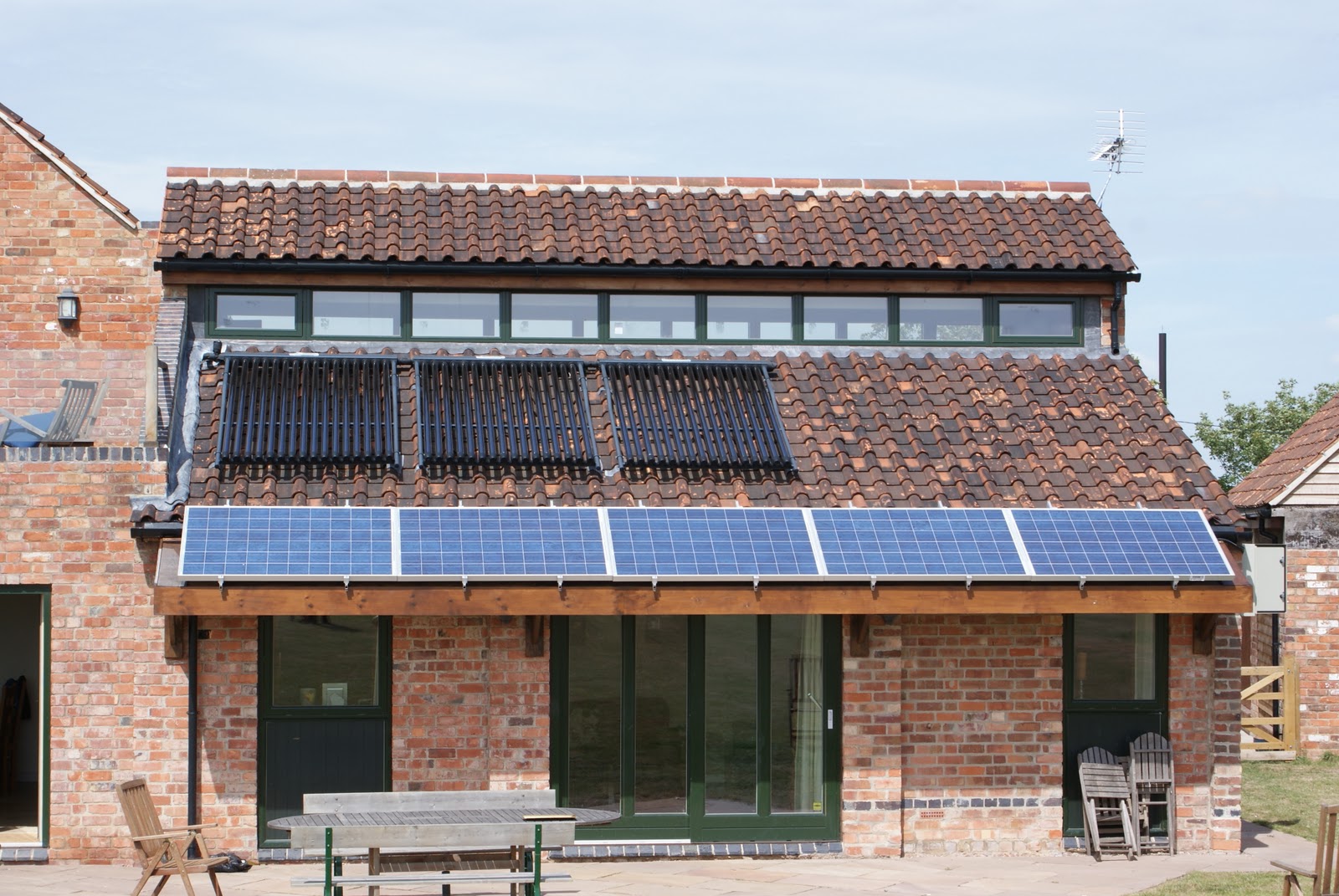


(For anyone who attended the series of Eco House Seminars which we ran this time last year, you may remember that David presented a talk on low energy refurbishment, and also contributed to the seminar on renewable energy for homes.)
For more information or to book your place on this free event, email Tina on info@wbecohouses.co.uk
Here is David's summary of the house:
· Super insulated 9” solid brick walls
· Factory made Insulated roof panels (SIPS)
· Super insulated floor slab with wet under floor heating (ground and first floor)
· Extensive use of thermal mass in floors, internal walls and ceiling
· Whole house ventilation with heat recovery 90% efficiency
· Triple glazed timber windows with aluminium outer skin (Rationel)
· Draft lobby with highly insulated doors (Rationel)
· Air tight construction with measured value of 2.3m3/m2@50Pa pressure
· Thermal store fed by oversized Solar Hot water panels and heat pump for space heating and domestic hot water
· 10kwp Solar PV system installed in December which should make us carbon neutral in energy use. Half of the system also feeds a new type of inverter (Nedap Powerrouter). This will do 5 important tasks: Send power to the house as it is required, when the house does not need the power divert it to a large battery store, in the evening when the house is calling for electricity turn the battery power into AC and send it to the house, during the day if the house does not need power and the batteries are fully charged then export power to the grid, should the Mains Grid supply fail then the unit will continue to feed converted power from the batteries into the house independently.
· Ground sourced heat Pump (GSHP) providing space heating and some of the domestic hot water
· Experimental Sunbox providing Earth charging energy from solar and ambient air to improve the efficiency of the GSHP
· Rain water recycling from underground tank to provide water for toilet flushing and garden irrigation
· Presence and daylight sensor light control in common areas of the house
· 100% low energy lighting and low energy appliances
· Planning permission and foundation pad for a 10-15kw VAWT wind turbine for when I find one that works!
· Reserve wood pellet 5kw stove in case of power failure
Interesting
facts/results:
· It works!· It has met its target energy consumption with 3 years’ worth of all power consumption (electricity) 10,500kwh/year
· If we had the 10kw wind turbine (long story) or when we install the 10kw or bigger Solar PV installation then the house will generate as much or more power than it consumes.
· It may also provide free electricity to charge 2 electric cars the first of which is due to arrive in 2012
· The family loves it because it is comfortable and pleasant to live in all year round
Monday, September 26, 2011
AECB annual conference
The annual conference for the Sustainable Builders Association (AECB) took place on 16th and 17th September this year in Nottingham, and I went along to it for the first time. As a home-owner rather than a building professional, I thought I might be out of my depth, but I had a wonderful time and can highly recommend it!
A large part of this year's focus was on retrofit, but talks and workshops covered a wide range of topics, including:
- The launch of the AECB's "Less is More - Energy Security after Oil" discussion paper by David Olivier
- Renovating existing homes and creating new buildings to Passive House standard
- Embodied carbon and sustainability of buildings and materials
There was also a talk on "a community network promoting energy efficient buildings" - by me, about Transition West Bridgford's Eco House Group, the events organised over the last 18 months, and this blog!
If you are thinking about starting a major low-energy or sustainable refurbishment (or new build), it is worth joining the AECB as a supporter member (for about £40+), just for the useful documents that you can then download. But there is much more on the website - a forum, articles, courses, the chance to find out who's who and what some of the UK's leading sustainable builders and architects (etc.) are working on, and events for local groups.
http://www.aecb.net/
A large part of this year's focus was on retrofit, but talks and workshops covered a wide range of topics, including:
- The launch of the AECB's "Less is More - Energy Security after Oil" discussion paper by David Olivier
- Renovating existing homes and creating new buildings to Passive House standard
- Embodied carbon and sustainability of buildings and materials
There was also a talk on "a community network promoting energy efficient buildings" - by me, about Transition West Bridgford's Eco House Group, the events organised over the last 18 months, and this blog!
If you are thinking about starting a major low-energy or sustainable refurbishment (or new build), it is worth joining the AECB as a supporter member (for about £40+), just for the useful documents that you can then download. But there is much more on the website - a forum, articles, courses, the chance to find out who's who and what some of the UK's leading sustainable builders and architects (etc.) are working on, and events for local groups.
http://www.aecb.net/
Sunday, September 11, 2011
Three contrasting eco-houses
Local architect Julian Marsh has passed me details of an ultra-low energy refurbishment in Nottingham city centre - converting a lacemaker's house into an up-to-date eco home. Click Lacemaker's house to view.
If you are looking for more modest refurbishment ideas (including low cost improvements), have a look at LowEhouses.
And if you'd like to read more about the very interesting eco home that Julian Marsh made for himself (below) on the site of an old meat factory, click here.

If you are familiar with the Passive House methodology, this offers a different approach to achieving a sustainable home which Julian calls the Active House approach.
(The text has kindly been made available to us by the Architect's Journal from this article in their March 2011 issue. www.architectsjournal.co.uk)
If you are looking for more modest refurbishment ideas (including low cost improvements), have a look at LowEhouses.
And if you'd like to read more about the very interesting eco home that Julian Marsh made for himself (below) on the site of an old meat factory, click here.

If you are familiar with the Passive House methodology, this offers a different approach to achieving a sustainable home which Julian calls the Active House approach.
(The text has kindly been made available to us by the Architect's Journal from this article in their March 2011 issue. www.architectsjournal.co.uk)
Thursday, September 08, 2011
Low E refurb design
If you are wondering how much money you can save by using different energy saving measures, here is a 2 page document which may help - sent to me by architect Julian Marsh.
This is a design proposed for a refurbishment of a typical terraced house in the Meadows area of Nottingham, but it is broadly applicable to many solid wall homes. It includes both low cost measures and higher cost measures to create a predicted 88% reduction in CO2 emissions with a comparatively modest outlay.
This house, when refurbished, will be used as a show home to illustrate the technologies, their costs and benefits to the public. To view, go to:
https://docs.google.com/viewer?a=v&pid=explorer&chrome=true&srcid=0B2fTJ8MNPf4tM2I3NmM4YTUtMDVlYi00MmI2LTk3NTQtYzU2YjEwNTI1ZTNi&hl=en_US
It is not the only interesting projects running in the Meadows. For more information about MOSES (Meadows Ozone Energy Services, a community owned energy company, go to http://www.meadowspartnershiptrust.org.uk/energy/mozes.aspx)
This is a design proposed for a refurbishment of a typical terraced house in the Meadows area of Nottingham, but it is broadly applicable to many solid wall homes. It includes both low cost measures and higher cost measures to create a predicted 88% reduction in CO2 emissions with a comparatively modest outlay.
This house, when refurbished, will be used as a show home to illustrate the technologies, their costs and benefits to the public. To view, go to:
https://docs.google.com/viewer?a=v&pid=explorer&chrome=true&srcid=0B2fTJ8MNPf4tM2I3NmM4YTUtMDVlYi00MmI2LTk3NTQtYzU2YjEwNTI1ZTNi&hl=en_US
It is not the only interesting projects running in the Meadows. For more information about MOSES (Meadows Ozone Energy Services, a community owned energy company, go to http://www.meadowspartnershiptrust.org.uk/energy/mozes.aspx)
Thursday, July 21, 2011
Visions of a Zero Carbon Britain
Saturday 16th July was Zero Carbon Britain Day, and 50 people braved the rain to take part in the first event in our Eco Houses Under Construction series. However, there is a lot more to a zero carbon lifestyle than an ultra-low energy house. For an entertaining glimpse into what a Zero Carbon lifestyle might look like....
A play based on Zero Carbon Britain is available to BBC iPlayer. The play "Getting to Zero" features Paul Allen and Peter Harper (Centre for Alternative Technology) and also George Monbiot. The play was originally broadcast as one of Radio 4's Afternoon plays. To hear it click here
A play based on Zero Carbon Britain is available to BBC iPlayer. The play "Getting to Zero" features Paul Allen and Peter Harper (Centre for Alternative Technology) and also George Monbiot. The play was originally broadcast as one of Radio 4's Afternoon plays. To hear it click here
Houses to visit and useful info
As well as our next "Eco Houses Under Construction" event on Saturday 30th July (email info@wbecohouses.co.uk if you want to come along), here are some other projects that may be of interest...
Here is a little summary of some useful information and visits that have been sent to me by other members of the Eco House Group.
Jerome sent me this link - it is something that Nottingham Energy Partnership has developed to support domestic refurb:
http://www.superwarmzone.com/interactiveecohouse
Ian has sent a link about some other low carbon houses to visit. If you don't mind travelling a bit, then the BRE open days may be for you:
http://www.bre.co.uk/eventdetails.jsp?id=5158
To get a view of a high-tec future, look out for this development in the Derby area which is in the final stages of completion now. Once finished, the show home will be open to visitors:
http://www.zerocarbonhub.org/examplepdfs/Shine_ZC_Derby_2011414_12126875.pdf
Here is a little summary of some useful information and visits that have been sent to me by other members of the Eco House Group.
Jerome sent me this link - it is something that Nottingham Energy Partnership has developed to support domestic refurb:
http://www.superwarmzone.com/interactiveecohouse
Ian has sent a link about some other low carbon houses to visit. If you don't mind travelling a bit, then the BRE open days may be for you:
http://www.bre.co.uk/eventdetails.jsp?id=5158
To get a view of a high-tec future, look out for this development in the Derby area which is in the final stages of completion now. Once finished, the show home will be open to visitors:
http://www.zerocarbonhub.org/examplepdfs/Shine_ZC_Derby_2011414_12126875.pdf
Thursday, February 10, 2011
House in the Meadows is a cheerfully good example!

8 Feb '11: DNC writes: I met Julian Marsh, one of my architect friends today, who was visiting the Dept of Arch and Built Environment. He has a self designed house in Nottingham and is the architect of the highly excellent Green St houses in the Meadows. He promotes the idea of the 'Active house' as better than Passive house, a sort of cheerful British interpretation of the slightly joyless German ideal.
That idea is more like the Peveril solar house, where you don't have to live in a airtight box, dependent on a fan for breathing. You make sensible use of the PV and a heat pump, open the windows in summer for ventilation, have a sunspace with openable shutters, allow the occupants to make sensible energy saving decisions such as solar shading by day or closing curtains at night. Architecturally, it is quite unique, a great way to use a corner site.
Like me, he has been monitoring his energy figures, to try to get below carbon zero. I will invite him as a speaker to one of our West Bridgford Ecohouses meetings in the future.
I gather that Julian's house is about as carbon zero as the Peveril house, i.e. is covering the heating, and more than that, but with the 4kW limit on PV panels in the British Feed in tariff, he doesn't have enough PV to cover the entire electrical consumption. With being on a corner site, he has two party walls, so has fewer external wall surfaces to lose heat - and doing a big favour to the adjoining neighbours!
I gather that Julian's house is about as carbon zero as the Peveril house, i.e. is covering the heating, and more than that, but with the 4kW limit on PV panels in the British Feed in tariff, he doesn't have enough PV to cover the entire electrical consumption. With being on a corner site, he has two party walls, so has fewer external wall surfaces to lose heat - and doing a big favour to the adjoining neighbours!
He does have a small amount of MVHR, but not on the whole house - uses it on the most lived-in zones of the house. He also has rainwater collection and a host of eco-materials, recycled timber beams, bottle walls and much more. The articles in the links below provide additional information.
In 10 March 2011, the Architects Journal devoted a long feature article to Julian's house. (Unfortunately there's a paywall on the AJ website, but if you are a subscriber it is visible)
also visible are these links:
In 10 March 2011, the Architects Journal devoted a long feature article to Julian's house. (Unfortunately there's a paywall on the AJ website, but if you are a subscriber it is visible)
also visible are these links:
Tuesday, December 21, 2010
Clearer definition of 'Carbon Zero'
16 December '10:
Quote: A Task Group convened by the Zero Carbon Hub has delivered a report to the Minister for Housing and Local Government setting out its recommendations for carbon compliance levels for new homes from 2016. Carbon Compliance – that is, on-site reductions in emissions – form part of the Government’s overall plan for achieving zero carbon homes; the other part comprises off-site "allowable solutions."
Read: http://www.ukgbc.org/site/news/show-news-details?id=350
for the details.
One thing they define numerically:
The recommendations are that the 'built performance' emissions from new homes should not exceed:
10 kg CO2(eq) /m2/year for detached houses
11 kg CO2(eq) /m2/year for other houses
14 kg CO2(eq) /m2/year for low rise apartment blocks
What does this mean? The Carbon Trust site gives some help from a table published in 2009:
Conversion to CO2e (gross CV basis)
Grid electricity kWh =0.544 Kg CO2e per unit
Natural gas kWh 0.184 Kg CO2e per unit
LPG kWh 0.214 Kg CO2e per unit
LPG litres 1.497 Kg CO2e per unit
Gas oil kWh 0.277 Kg CO2e per unit
Gas oil litres 3.029 Kg CO2e per unit
Fuel oil kWh 0.266 Kg CO2e per unit
Fuel oil tonnes 3229 Kg CO2e per unit
Burning oil kWh 0.247 Kg CO2e per unit
Burning oil tonnes 3165 Kg CO2e per unit
Diesel kWh 0.253 Kg CO2e per unit
Diesel litres 2.669 Kg CO2e per unit
Petrol kWh 0.243 Kg CO2e per unit
Petrol litres 2.331 Kg CO2e per unit
Industrial coal kWh 0.313 Kg CO2e per unit
Industrial coal tonnes 2,338 Kg CO2e per unit
Wood pellets kWh 0.026 Kg CO2e per unit
Wood pellets tonnes 121.5 Kg CO2e per unit
Quote: A Task Group convened by the Zero Carbon Hub has delivered a report to the Minister for Housing and Local Government setting out its recommendations for carbon compliance levels for new homes from 2016. Carbon Compliance – that is, on-site reductions in emissions – form part of the Government’s overall plan for achieving zero carbon homes; the other part comprises off-site "allowable solutions."
Read: http://www.ukgbc.org/site/news/show-news-details?id=350
for the details.
One thing they define numerically:
The recommendations are that the 'built performance' emissions from new homes should not exceed:
10 kg CO2(eq) /m2/year for detached houses
11 kg CO2(eq) /m2/year for other houses
14 kg CO2(eq) /m2/year for low rise apartment blocks
What does this mean? The Carbon Trust site gives some help from a table published in 2009:
Conversion to CO2e (gross CV basis)
Grid electricity kWh =0.544 Kg CO2e per unit
Natural gas kWh 0.184 Kg CO2e per unit
LPG kWh 0.214 Kg CO2e per unit
LPG litres 1.497 Kg CO2e per unit
Gas oil kWh 0.277 Kg CO2e per unit
Gas oil litres 3.029 Kg CO2e per unit
Fuel oil kWh 0.266 Kg CO2e per unit
Fuel oil tonnes 3229 Kg CO2e per unit
Burning oil kWh 0.247 Kg CO2e per unit
Burning oil tonnes 3165 Kg CO2e per unit
Diesel kWh 0.253 Kg CO2e per unit
Diesel litres 2.669 Kg CO2e per unit
Petrol kWh 0.243 Kg CO2e per unit
Petrol litres 2.331 Kg CO2e per unit
Industrial coal kWh 0.313 Kg CO2e per unit
Industrial coal tonnes 2,338 Kg CO2e per unit
Wood pellets kWh 0.026 Kg CO2e per unit
Wood pellets tonnes 121.5 Kg CO2e per unit
Wednesday, December 01, 2010
Government redefines 2016 target
29 Nov '10: DNC writes: Regrettably, but inevitably the coalition government have bowed to the pressure from the commercial house-builders and dropped / redefined the 2016 target.
http://www.communities.gov.uk/news/corporate/1779881
I am not surprised for two reasons, 1. The house builders have tremendous influence with a goverment that is trying to make a bonfire of regulations, and 2. The 2016 target was extremely difficult to meet if you took it quite literally. It has never been totally clear what Carbon-Zero means anyway, does it cover the heating cost, or must it cover the entire heating, hotwater and power requirements? Here's a page from the Guardian trying to define it:
http://www.guardian.co.uk/environment/2009/aug/04/zero-carbon-homes
The german Passivhaus standard is very clear, although it is extremely prescriptive, and no doubt house-builders will hate that too.
To make matters worse, the Government invites developers to make suggestions for further deregulation of the industry.
However, the good thing seems to be that there is greater encouragement for renewable technology, power generation etc. to compensate for the house itself not being carbon zero in the Passivhaus sense. PV is a major part of this new strategy, so if you are in the business of designing houses, make sure they have clear south facing roofs! (if you weren't doing it before). As PV is a choice that the householder can make, presumably this is shifting much of the cost from the developers to the occupants.
There is more information and diagrams here: http://www.ukgbc.org/site/document/download/?document_id=985
As you would expect, the eloquent Georges Monbiot is able to deliver powerful criticism of this policy change.
http://www.guardian.co.uk/environment/georgemonbiot/2010/nov/26/zero-carbon-homes
Sorry to namedrop here, but I met David Miliband in 2007 at the Hay Festival when he was Energy minister. I told him that 'Carbon-Zero' was somewhat mythical and could not be achieved by builders of affordable mass housing in suburban environments (with whatever certainty I have from working at the University in a department full of people trying to do this). He brushed this aside politely assuring me that his experts thought it would be possible. About a week later, he was no longer Energy Secretary, handing over to his brother, Ed. This is why I am not totally surprised by the Government's decision.
Thanks to this decision, this definition does make my house Carbon Zero, as the PV generates 3,325 kWh/yr and the Space Heating cost is 3,000 kWh/yr of electricity...
http://www.communities.gov.uk/news/corporate/1779881
I am not surprised for two reasons, 1. The house builders have tremendous influence with a goverment that is trying to make a bonfire of regulations, and 2. The 2016 target was extremely difficult to meet if you took it quite literally. It has never been totally clear what Carbon-Zero means anyway, does it cover the heating cost, or must it cover the entire heating, hotwater and power requirements? Here's a page from the Guardian trying to define it:
http://www.guardian.co.uk/environment/2009/aug/04/zero-carbon-homes
The german Passivhaus standard is very clear, although it is extremely prescriptive, and no doubt house-builders will hate that too.
To make matters worse, the Government invites developers to make suggestions for further deregulation of the industry.
However, the good thing seems to be that there is greater encouragement for renewable technology, power generation etc. to compensate for the house itself not being carbon zero in the Passivhaus sense. PV is a major part of this new strategy, so if you are in the business of designing houses, make sure they have clear south facing roofs! (if you weren't doing it before). As PV is a choice that the householder can make, presumably this is shifting much of the cost from the developers to the occupants.
There is more information and diagrams here: http://www.ukgbc.org/site/document/download/?document_id=985
As you would expect, the eloquent Georges Monbiot is able to deliver powerful criticism of this policy change.
http://www.guardian.co.uk/environment/georgemonbiot/2010/nov/26/zero-carbon-homes
Sorry to namedrop here, but I met David Miliband in 2007 at the Hay Festival when he was Energy minister. I told him that 'Carbon-Zero' was somewhat mythical and could not be achieved by builders of affordable mass housing in suburban environments (with whatever certainty I have from working at the University in a department full of people trying to do this). He brushed this aside politely assuring me that his experts thought it would be possible. About a week later, he was no longer Energy Secretary, handing over to his brother, Ed. This is why I am not totally surprised by the Government's decision.
Thanks to this decision, this definition does make my house Carbon Zero, as the PV generates 3,325 kWh/yr and the Space Heating cost is 3,000 kWh/yr of electricity...
Friday, October 29, 2010
Climate change lecture

Peter started by reminding us of our obligations to future generations "The Fierce Urgency of Now". If you are lucky enough to have grandchildren, it reminds you starkly of the risks they face in the future. In all other aspects of life, we take precautions when we see a risk, we don't wait until after the house burns down before taking out insurance. The Stern Review of 2006 makes an economic case for taking care to combat climate change now, rather cheaper than waiting until after the disasters have occurred (and when major climate-responsible ones do occur, such as the floods in Pakistan does it affect public opinion in USA and UK? probably not...)
We are getting close to a point in time... a parting of the ways... that future historians will look back to and say "in that decade, when CO2 levels were ***, that would have been the time to finally face up to the risk, the runaway effect started then". Once the runaway effect occurs, the time scale will be hundreds of human generations, as occurred with previous climate cycles. A Zero Carbon approach will be tackling both Peak oil and Climate Change, interlinked issues, both urgent.
Different countries are at different stages - the developed world is burning more than the planet can support, but is recognising it has to cut back energy consumption, the middle world is enjoying its new affluence, and the developing world expects to reach a higher standard of living in the future - all 'high standards of living' involve high energy consumption.
What effect can dear little Britain have? a mere 2% of the population? Well.... with climate change we are not one single country in an air tight box. All countries share the same air, so we must all be concerned, and if we wait for the others, nothing will happen. Some countries (i.e.the UK), the ones who consume MOST should be leading by example and a bit of self sacrifice (some energy abstinence).
Hence, the Zero Carbon Britain 2030 report presented to the government in 2010. We can identify three main tasks, 1. the Reduction of demand for energy, 2, Improved delivery of Zero carbon energy supply, and 3. Net negative processes to reverse the levels of CO2 such as planting and sequestration.
The first one, which influences our actions and decisions is TO POWER DOWN! UK buildings and construction are more than half the CO2 emission, we need not just ecohouses, but to retrofit every building in the country, millions of which are insufficiently insulated. We need a shift in our Transport, to use more public transport, travel less, avoid air transport, more trains, more sharing and cycling. We need to rethink the generation of Electricity - much more wind power (on a large scale, enough to overcome intermittency), develop ways of storing energy, e.g. with heatpumps, and we should consider a European Supergrid - for example, solar power delivered by the hot southern countries, hydro from the north and wind power from the coastal countries, and sharing of nuclear if we have to have it.
Local generation, such as domestic PV is important for stabilising grid and reducing transmission losses.
For the UK, there is an abundance of Wind in the North sea, and if the country invested as much in that as it did in the oil rigs of the 80s and 90s, there would be a source of energy that could never run out. Electric cars are improving in performance, image and range. Hydrogen - which the US favours - is a great technology, but it has been promised for the last 40 years and still seems to be in a state of infancy, with so little delivered or accepted.
Agriculture is a major user of energy, but crop production uses vastly less energy and land than meat production. More land could be devoted to Biomass farming if we grew less meat, and crop growing reduces CO2 levels. The overpopulation of grazing animals emit Methane and Nitrous Oxide, both greenhouse gases. We have managed a paradigm change in land use before - in the early 1900s much of our land was still devoted to horses, our previous prime form of transport. We made a major change in 100 years - much of the land devoted to airports, motorways, transport depots, and large scale farming, with the space for horses statistically negligible. Peter brought up the idea of Carbon Farming - a policy of financial incentives for farmers to grow crops not animals.
One of the problems for the environmental movement, in our efforts to influence government, is that we have conflicting objectives, perhaps because we interpret 'environment' differently. We may all want to stop global warming, but some will also say Nuclear No Thanks, others to Save our Land from Wind Turbines, others No to Trams or No to Tidal barrages. Some propose Carbon Offsetting, but does that work? Some propose Carbon Capture and storage (whatever the cost) but does that work? Could Biofuels enable us to continue our consumptive lifestyle - we think not! Can Lifestyle changes bring down energy consumption? yes, but who is the first to turn off the lights? Can we invest in giant geo-engineering schemes to get heat from below?
But in the face of the major hazards ahead, we should be prepared to consider Every possible option, have no taboo about discussing them, we have to be prepared to compromise our faith or opinions if necessary to achieve the larger target.
A full copy of the Zero Carbon 2030 book is available free as a PDF on line.
David NC writes: I hope you enjoyed this summary of Peter's talk, now I hope you will enjoy seeing the full copy of the document on line!
Tuesday, August 31, 2010
2016 Target to be modified
30 Aug: DNC writes: Water down the 2016 target? Methinks that this was bound to happen:
www.guardian.co.uk/business/2010/aug/29/new-houses-carbon-emission-targets-reduced
www.guardian.co.uk/business/2010/aug/29/new-houses-carbon-emission-targets-reduced
3 years ago I met David Miliband, then Energy Secretary, at the Hay Festival. he is actually very approachable, although personally, I am more likely to vote for his brother Ed Miliband who has been a far more effective Energy Secretary since 2007 - we have him to thank for the Feed in Tariff. In the discussion I told Mr David M that the zero carbon target for 2016 was impossible, it is too tough a standard for 100% of homes to meet, both technically (systems etc), environmentally (microclimate effects in high density cities) and economically (getting builders to do it affordably!).
Being in the trade, I know how impossible a target it is to meet in any one of those areas. Unless you build freakishly specialised houses like Hockerton, it ain't gonna happen!
Being in the trade, I know how impossible a target it is to meet in any one of those areas. Unless you build freakishly specialised houses like Hockerton, it ain't gonna happen!
He persisted in parroting the official 2016 line.
This new decision is not a backing down, it seems more like getting to grips with reality. The idea of softening the target was mooted a month ago (27 July), but it would be done by getting builders to pay into a Carbon Offsetting fund, a bit like air travellers paying into a tree planting website to overcome their guilt for flying - but even this is too difficult for housebuilders, it will still put the cost up, and are there enough tree planting schemes to absorb all that money?
The previous 2016 target was as dogmatic and untested as Blair's idea of 50% of the population going to University, but then bumping the fees up astronomically. It is actually considerably more difficult than Kennedy's famous ten year promise to send a man to the moon by 1970.
btw, This is an interesting site: http://www.zerocarbonhub.org/
Subscribe to:
Posts (Atom)