We have some good news. Marches Energy Agency (MEA) has been appointed as an Expert Consultant for the Energy Saving Trust’s Green Communities program. There is no charge to community groups for any of the services which are available, which includes support with:
Carbon saving in a community building- identifying opportunities for ‘easy wins’ and energy efficiency improvements.
Community-scale renewables- pre-feasibility studies for larger renewable energy systems which could be owned and operated by a whole community.
Long term carbon reduction action planning- shaping your groups ideas into a credible and effective long term action plan which can be monitored while it is achieved.
Business planning for carbon saving projects- developing opportunities for self-sustaining businesses associated with community-scale climate-change projects
This is a great opportunity to secure additional support to expand upon what has gone before, or to address any new issues.
Working through Green Communities, MEA can assist you to develop and improve your community energy project, build partnerships and access funding. Following a consultation (which may include a site visit) you will receive a review of your proposed project and a short report outlining clear recommendations for further action.
To receive this free support, you will need to complete and return the Green Communities application form. I have attached a copy of the form, although the Energy Saving Trust strongly recommends that you refer to their helpline for guidance with completion. The application process is relatively informal and Green Communities allow you to indicate a preference in the application for the consultant you want to provide the support you are requesting – there isn’t a specific section for this but we suggest you add it at the bottom of section 2 or at the bottom of the form – please do refer to previous work with MEA, and request further impartial support from one of MEA’s Expert Consultants for your current project.
To find out more about Green Communities please visit http://www.energysavingtrust.org.uk/cafe/Green-Communities/Project-Support/Green-Communities-Expert-Support or call the helpline on 0844 848 0077.
Kind Regards
Caroline Harmon
Friday, January 21, 2011


Low-flush toilets
There are many low-flush toilets now available, but watch out - some suffer from the problem of leaky drop valves.
At Monday’s event on saving water, Jon mentioned the 'interflush' water saving device for toilets with a traditional siphon flushing cistern. There's a lot of information about it on the website, including pictures, diagrams etc.:
Since postage is free when ordering more than one, Jon would be interested in putting in a shared order if anyone else is thinking of getting one. If you might be, just email info@wbecohouses.co.uk for more info.
Alternatively, if you are thinking of getting a new toilet, there are leak-free low flush toilets available - try the ES4 (a 4 litre single flush available from the Green Building Store.
At Monday’s event on saving water, Jon mentioned the 'interflush' water saving device for toilets with a traditional siphon flushing cistern. There's a lot of information about it on the website, including pictures, diagrams etc.:
Since postage is free when ordering more than one, Jon would be interested in putting in a shared order if anyone else is thinking of getting one. If you might be, just email info@wbecohouses.co.uk for more info.
Alternatively, if you are thinking of getting a new toilet, there are leak-free low flush toilets available - try the ES4 (a 4 litre single flush available from the Green Building Store.
Thursday, January 20, 2011
Ways to Save Water
The 4th in a series of events held at South Notts College in Ruddington focused on saving water in the home. Here is a short summary of the talks, and some useful facts are listed below. It’s a big topic so just a small selection included here.
Tina Holt gave an overview. In summary, water-saving habits really make a huge difference in the amount of water consumed in the home. Hot water has a much higher carbon footprint than cold water (about 5 times higher), so cut your heating bills and save carbon by insulating taps and pipes and using hot water carefully.
David Roe explained his home-made rainwater harvesting system, which supplies water to toilets, washing machine and dishwasher. To buy such a system new would be very expensive and is not as eco-friendly as it seems. However, using reused tanks and some basic pipework, this home-made approach has a very low carbon footprint.
Ian Mumford showed how to avoid paying the surface drainage charge by re-directing all the water from his roof into water-butts, and from there via pipes across his garden. There would be a big environmental benefit if every house with a garden could do this, because after heavy rain, water falling on the house and driveway normally flows rapidly into the drains and rivers and can cause flooding. However, when this water is diverted into the garden, instead of adding to the flooding problem, it feeds the local soil and sub-soil. From here it can make its way gradually into rivers, lakes and groundwater – which are all sources of our mains water supply.
Gil Shalom shared 10 years’ experience of saving water in a retrofit eco-home. Surprisingly, simple water saving habits and low flush toilets were his top tips, along with shorter showers.
Watch out – many types of low flush toilets leak from the cistern into the loo and waste huge amounts of water. If you are looking for a leak-free low flush loo, try the ES4 (a 4 litre single flush available from the Green Building Store).
If you are careful with water, being on a water meter may be cheaper than the rate-based water bill. (Try to estimate your water use accurately for a week and estimate your likely bill from the pricing information on the Severn Trent website). Or instead, try this simple water calculator: http://www.ccwater.org.uk/server.php?show=nav.388 All you need to do is download the excel document and go to the “Severn Trent” tab.
Tina Holt gave an overview. In summary, water-saving habits really make a huge difference in the amount of water consumed in the home. Hot water has a much higher carbon footprint than cold water (about 5 times higher), so cut your heating bills and save carbon by insulating taps and pipes and using hot water carefully.
David Roe explained his home-made rainwater harvesting system, which supplies water to toilets, washing machine and dishwasher. To buy such a system new would be very expensive and is not as eco-friendly as it seems. However, using reused tanks and some basic pipework, this home-made approach has a very low carbon footprint.
Ian Mumford showed how to avoid paying the surface drainage charge by re-directing all the water from his roof into water-butts, and from there via pipes across his garden. There would be a big environmental benefit if every house with a garden could do this, because after heavy rain, water falling on the house and driveway normally flows rapidly into the drains and rivers and can cause flooding. However, when this water is diverted into the garden, instead of adding to the flooding problem, it feeds the local soil and sub-soil. From here it can make its way gradually into rivers, lakes and groundwater – which are all sources of our mains water supply.
Gil Shalom shared 10 years’ experience of saving water in a retrofit eco-home. Surprisingly, simple water saving habits and low flush toilets were his top tips, along with shorter showers.
Watch out – many types of low flush toilets leak from the cistern into the loo and waste huge amounts of water. If you are looking for a leak-free low flush loo, try the ES4 (a 4 litre single flush available from the Green Building Store).
If you are careful with water, being on a water meter may be cheaper than the rate-based water bill. (Try to estimate your water use accurately for a week and estimate your likely bill from the pricing information on the Severn Trent website). Or instead, try this simple water calculator: http://www.ccwater.org.uk/server.php?show=nav.388 All you need to do is download the excel document and go to the “Severn Trent” tab.
Friday, January 14, 2011
Where does your electricity come from?
 13 Jan '11: Electricity companies are obliged to reveal their sources of power, but not all of them are keen to make it too obvious. Ecotricity, for example make a big fuss about this, even in the choice of their name, yet they are using a proportion of Nuclear power, presumably because by some definition the lack of burning coal makes it green, somehow.
This website, electricityinfo.org is useful because it does show an up to date breakdown of the sources for each company. The only one that I can find that is 100% renewable based (Wind farms, home microgeneration etc) is Good Energy.
There is a click link from this site to a 'Green Energy selector' which compares tariffs from companies who have sizeable proportions of renewable energy as their course.
http://www.electricityinfo.org/suppliers.php List of Suppliers and their green component.
http://www.greenelectricity.org/ Another site that enables you to compare green tariffs and make the switch. Good Energy are more expensive than others, but they are the only 100% renewable.
Wednesday, January 12, 2011
Ways to Save Water in the home
Monday 17th January 2011
7pm for refreshments, prompt start at 7.30pm
SNC Training, South Notts College
Mere Way, Ruddington Fields Business Park, NG11 6JZ
The fourth in a series of free events.
Including:
It’s always raining – surely we have plenty of water?
Would a water meter save me money?
Low flow taps, showers and low flush loos
Saving hot water
Greywater and rainwater systems
Water diversion
What’s eco and what’s not? What saves money and what doesn’t?
Talks by: Members of the Eco House Group and others who have saved water in their own homes by different methods, plus a chance to ask your questions.
On a water meter already? Can you bring along your average monthly water use in cubic metres or in litres, and what that costs? Just a bit of fun – we want to compare the numbers with standard water rates, not to embarrass anyone.
Please email info@wbecohouses.co.uk if you are likely to be attending.
Directions: Follow Mere Way through Ruddington Fields Business Park. Pass the first SNC building on the left, and take the next turning to the second SNC Training building. It has a distinctive suspended curved wall with car parking beneath it. Park here or on the roadside.
Buses to Ruddington village: Ruddington Connection (Trent Barton) & No. 10 (Nott City Transport)
The Eco House Group is a project inspired by Transition West Bridgford
7pm for refreshments, prompt start at 7.30pm
SNC Training, South Notts College
Mere Way, Ruddington Fields Business Park, NG11 6JZ
The fourth in a series of free events.
Including:
It’s always raining – surely we have plenty of water?
Would a water meter save me money?
Low flow taps, showers and low flush loos
Saving hot water
Greywater and rainwater systems
Water diversion
What’s eco and what’s not? What saves money and what doesn’t?
Talks by: Members of the Eco House Group and others who have saved water in their own homes by different methods, plus a chance to ask your questions.
On a water meter already? Can you bring along your average monthly water use in cubic metres or in litres, and what that costs? Just a bit of fun – we want to compare the numbers with standard water rates, not to embarrass anyone.
Please email info@wbecohouses.co.uk if you are likely to be attending.
Directions: Follow Mere Way through Ruddington Fields Business Park. Pass the first SNC building on the left, and take the next turning to the second SNC Training building. It has a distinctive suspended curved wall with car parking beneath it. Park here or on the roadside.
Buses to Ruddington village: Ruddington Connection (Trent Barton) & No. 10 (Nott City Transport)
The Eco House Group is a project inspired by Transition West Bridgford
Wednesday, January 05, 2011
Comparisons of three winters 08, 09 and 10
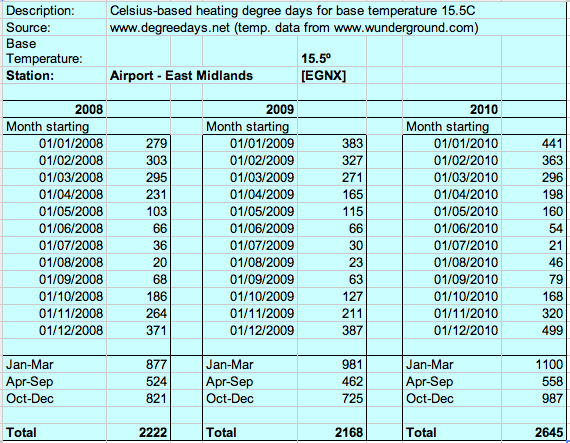
Degree Days are a good way to assess the thermal performance of the month and the year as they record the number of degrees during how many days that heating systems were required to bring the building up to a desired temperature.
We normally use 15.5º in degree day calculations on the basis that incidental gains are enough to make the temperature comfortable. This is a bit approximate, as in the recent winter, there has been little sun through windows, and with energy efficient lighting, appliances and cooking, the incidental gains are less than hoped for. Incidental gains in equinox times are perfect, but in December and January? Not much!
The figures above show the degree days on a month by month basis for Nottingham, for the last three years. 2008 was a very typical year, whereas 2009 was somewhat milder. The year of 2010 was truly more severe by 20%, with the very cold spring and the very cold winter occurring within the same calendar year.
I have split the year into 3 blocks which equate to the times I use for metering, Jan-Mar, Apr-Sep and Oct-Dec. As these figures are monthly, I can relate these to the consumption of the heating system, and generate a sort of index of performance.
The figures above show the degree days on a month by month basis for Nottingham, for the last three years. 2008 was a very typical year, whereas 2009 was somewhat milder. The year of 2010 was truly more severe by 20%, with the very cold spring and the very cold winter occurring within the same calendar year.

What does this mean graphically?
Well, it shows that there has been a cooling winter trend annually. Do not be deceived into thinking that this disproves 'global warming' because climate change globally is about change, AKA chaos. It does not result in every place getting warmer. Britain could get cooler if the Gulf Stream is affected by melting polar ice.
If you want more explanation about Degree Days, you are welcome to email DNC
Post script: The first day in 2010 that had evening temperature higher than 10.0º was 17 March! We have having a succession of days like that in mid January 2011.
Tuesday, January 04, 2011
Tina and Richard’s Eco-retrofit – the plan so far, January 2011.
We’ve lived in our 1950’s 3 bed detached house for one year now and much thought has gone into deciding what changes we’d like to make.
The “eco” wish-list includes:
• A generous porch on the front to minimise heat loss when entering/leaving the house.
• A utility room by the back door to create the same air-lock effect there.
• Super-insulate the loft conversion, the solid walls (externally) and the ground floor.
• Replace the single glazed windows with high quality timber framed windows (hopefully achieving a U value)
• Ensure air tightness of 3m3/m2 at 50 pa pressure, or less
• Install a mechanical ventilation system with heat recovery (MVHR)
• Replace the ailing gas boiler with suitable means of space and water heating
• Installing low-flow devices to reduce water use.
• Possibly add PV panels on the south-facing roof
In other words, we will apply to our house some of principles which form the basis of the Passivhaus standard - the highest standard for building homes with a low energy requirement.
The Passivhaus standard is for new buildings, but there is another standard being developed which is specifically for existing buildings. This is the EnerPHit standard for Passivhaus retrofit. Houses build to this standard will use about 80-85% less heat and power than the average home.
This is the standard that we are aiming towards – although we don’t know yet just how close we might be able to get. To see a relatively recent description of this standard (a draft document), go to the EnerPhit document from the Passivhaus Institute
The “eco” wish-list includes:
• A generous porch on the front to minimise heat loss when entering/leaving the house.
• A utility room by the back door to create the same air-lock effect there.
• Super-insulate the loft conversion, the solid walls (externally) and the ground floor.
• Replace the single glazed windows with high quality timber framed windows (hopefully achieving a U value)
• Ensure air tightness of 3m3/m2 at 50 pa pressure, or less
• Install a mechanical ventilation system with heat recovery (MVHR)
• Replace the ailing gas boiler with suitable means of space and water heating
• Installing low-flow devices to reduce water use.
• Possibly add PV panels on the south-facing roof
In other words, we will apply to our house some of principles which form the basis of the Passivhaus standard - the highest standard for building homes with a low energy requirement.
The Passivhaus standard is for new buildings, but there is another standard being developed which is specifically for existing buildings. This is the EnerPHit standard for Passivhaus retrofit. Houses build to this standard will use about 80-85% less heat and power than the average home.
This is the standard that we are aiming towards – although we don’t know yet just how close we might be able to get. To see a relatively recent description of this standard (a draft document), go to the EnerPhit document from the Passivhaus Institute
Tuesday, December 28, 2010
Mobile access to the website

Well thanks to Google blogger, we have too! If you have a mobile phone, try this site with your iPhone or Android phone. (I hope it works for you).
I already use my iPhone as the hand held device for my PV roof, now it is even more useful, for checking my various blogs!
I notice that if you log onto the site with an iPad, it is treated as a computer, not as a phone, despite using the same operating system.
Wednesday, December 22, 2010
Results from an Eco House open day

Hi Karina
My panels are up and running - thanks again for allowing me to visit your house - it was helpful.
Tony
Tuesday, December 21, 2010
Saving Water Event
After the mini event on Renewables on Friday 3rd December at the Test Match Pub, the next main event will be on
17th January 2011, focusing on Saving Water. More info on that in the coming weeks… This would be at the South Notts College building, in Ruddington.
However, if you are looking into water saving devices right now you might be interested in the following: I've entered the competition at SaveWaterSaveMoney to have a chance of winning one or more of the 250 prizes worth over £8,000.
If you click on the link below and enter your details, then we both stand a better chance of winning. Click Here
Clearer definition of 'Carbon Zero'
16 December '10:
Quote: A Task Group convened by the Zero Carbon Hub has delivered a report to the Minister for Housing and Local Government setting out its recommendations for carbon compliance levels for new homes from 2016. Carbon Compliance – that is, on-site reductions in emissions – form part of the Government’s overall plan for achieving zero carbon homes; the other part comprises off-site "allowable solutions."
Read: http://www.ukgbc.org/site/news/show-news-details?id=350
for the details.
One thing they define numerically:
The recommendations are that the 'built performance' emissions from new homes should not exceed:
10 kg CO2(eq) /m2/year for detached houses
11 kg CO2(eq) /m2/year for other houses
14 kg CO2(eq) /m2/year for low rise apartment blocks
What does this mean? The Carbon Trust site gives some help from a table published in 2009:
Conversion to CO2e (gross CV basis)
Grid electricity kWh =0.544 Kg CO2e per unit
Natural gas kWh 0.184 Kg CO2e per unit
LPG kWh 0.214 Kg CO2e per unit
LPG litres 1.497 Kg CO2e per unit
Gas oil kWh 0.277 Kg CO2e per unit
Gas oil litres 3.029 Kg CO2e per unit
Fuel oil kWh 0.266 Kg CO2e per unit
Fuel oil tonnes 3229 Kg CO2e per unit
Burning oil kWh 0.247 Kg CO2e per unit
Burning oil tonnes 3165 Kg CO2e per unit
Diesel kWh 0.253 Kg CO2e per unit
Diesel litres 2.669 Kg CO2e per unit
Petrol kWh 0.243 Kg CO2e per unit
Petrol litres 2.331 Kg CO2e per unit
Industrial coal kWh 0.313 Kg CO2e per unit
Industrial coal tonnes 2,338 Kg CO2e per unit
Wood pellets kWh 0.026 Kg CO2e per unit
Wood pellets tonnes 121.5 Kg CO2e per unit
Quote: A Task Group convened by the Zero Carbon Hub has delivered a report to the Minister for Housing and Local Government setting out its recommendations for carbon compliance levels for new homes from 2016. Carbon Compliance – that is, on-site reductions in emissions – form part of the Government’s overall plan for achieving zero carbon homes; the other part comprises off-site "allowable solutions."
Read: http://www.ukgbc.org/site/news/show-news-details?id=350
for the details.
One thing they define numerically:
The recommendations are that the 'built performance' emissions from new homes should not exceed:
10 kg CO2(eq) /m2/year for detached houses
11 kg CO2(eq) /m2/year for other houses
14 kg CO2(eq) /m2/year for low rise apartment blocks
What does this mean? The Carbon Trust site gives some help from a table published in 2009:
Conversion to CO2e (gross CV basis)
Grid electricity kWh =0.544 Kg CO2e per unit
Natural gas kWh 0.184 Kg CO2e per unit
LPG kWh 0.214 Kg CO2e per unit
LPG litres 1.497 Kg CO2e per unit
Gas oil kWh 0.277 Kg CO2e per unit
Gas oil litres 3.029 Kg CO2e per unit
Fuel oil kWh 0.266 Kg CO2e per unit
Fuel oil tonnes 3229 Kg CO2e per unit
Burning oil kWh 0.247 Kg CO2e per unit
Burning oil tonnes 3165 Kg CO2e per unit
Diesel kWh 0.253 Kg CO2e per unit
Diesel litres 2.669 Kg CO2e per unit
Petrol kWh 0.243 Kg CO2e per unit
Petrol litres 2.331 Kg CO2e per unit
Industrial coal kWh 0.313 Kg CO2e per unit
Industrial coal tonnes 2,338 Kg CO2e per unit
Wood pellets kWh 0.026 Kg CO2e per unit
Wood pellets tonnes 121.5 Kg CO2e per unit
Sunday, December 05, 2010
Eco House Group at the Melton Road Christmas Fair
 Sunday 5th December, we shall be at the Melton Road Christmas Fair from noon until 4pm
We can be found in the Celebrations shop together with members of Rushcliffe Solar and the Skills Exchange. We shall have a raffle with 3 prizes: A Solar Security Light, A TV powerdown and a Solar trickle charger. All the proceeds will go to Transition West Bridgford to support current and future initiatives.
Post Event Report: Yes, we were there, but somewhat hidden at the back of the shop - and there were musical and filming events between us and the door! However, it was an extremely cold day, and we were glad to be indoors with a good supply of mulled wine only a couple of doors away at the Tall Frog.Our stand was a combination of Rushcliffe Solar, WB Ecohouses and WB Transition.
Saturday, December 04, 2010
Renewables "mini event" at the Test Match Pub

We put our questions to Chris Wheelwright of Solar-Heat and Paul Baker of The Fireplace Centre, and to David Hill and Pete of Carbon Legacy. David Nicholson-Cole (Rushcliffe Solar and University of Nottingham) was also there to provide extra expertise on PV, insulation and heat pumps.
There was a long discussion on Insulation, particularly external insulation - it's one of the most effective energy saving things you can do if your house doesn't have too many projecting bays or flush eaves details. Many of those present have solid wall houses, and require insulation. There was discussion of the best materials with Phenolic foam being preferred for performance and easy fixing, and there was discussion of the chance of a bulk or group deal for WB house owners.
There was detailed information on PV for Electricity generation, consideration of mono- and polycrystalline panels, best makes of panels and inverters, and questions that you might ask to sort the reputable installers from the less good. Even without asking an installer you can intelligently guess if the geometry, trees and chimneys make your house suitable for PV installation. They are far more sensitive than solar thermal panels which can tolerate some shading.
Ventilation systems with heat recovery cropped up again too, because many are considering a whole house approach to reducing energy needs, of which renewable energy recycling is part of the picture. For those who cannot fit whole house heat reclaim (because of the shape of the house or lack of space in the loft) it is possible to fit room-by room heat reclaim units which can go in the place of present day ventilators.
Friday, December 03, 2010
London Passivhaus explained by Bere
 3 Dec '10: This PDF of a lecture by Justin Bere is an excellent example of how architects design, and how a Passivhaus is assessed. Some of the work includes add ons to an existing victorian house.
http://www.aecb.co.uk/PDFs/conference09/delivering_ph_bere_col.pdf
There is a fascinating explanation for how this Passivhaus standard house was designed, with a long sequence of alternative planning ideas.
Crossway Passivhaus vaulted roof

Crossway house in Staplehurst, Kent, is by the architect Richard Hawke. It has been certified to the Passivhaus standard. It featured a few years ago on Grand Designs, as the very risky parabolic vault was being built. It is very well insulated, and with the addition of some renewables is well up to the standard. It is a unique design, nobody has built with vaults like this since Gothic times.
http://inhabitat.com/vaulted-green-roofed-passive-house-in-the-english-countryside/
I somehow don't see these appearing in West Bridgford.. but Colston Bassett? perhaps it is possible.
Thursday, December 02, 2010
Invitation from Helen to be involved in a straw bale build.
There is a straw bale ecobuild (a farm visitor centre, out at Screveton on the A46 past East Bridgford). You are invited to visit and I can show you round and tell you about the features of the build, with the owner’s permission (David Rose). There is a Farmeco Community Carefarm Facebook website which has some pictures of the build so far… http://www.facebook.com/group.php?gid=113825078645337&v=wall
We shall be looking for volunteers for lime rendering, and/or providing low cost introductory lime rendering courses, once the weather becomes more appropriate, and those who are interested in knowing about that can email David (see Farmeco webpages or david.rose@farmshop.net) to be on a contact list. David is very interested in getting people from the local communities involved at all stages, and so far, local people have been involved in the rammed earth wall and the straw bale wall-raising.
We shall be looking for volunteers for lime rendering, and/or providing low cost introductory lime rendering courses, once the weather becomes more appropriate, and those who are interested in knowing about that can email David (see Farmeco webpages or david.rose@farmshop.net) to be on a contact list. David is very interested in getting people from the local communities involved at all stages, and so far, local people have been involved in the rammed earth wall and the straw bale wall-raising.
Wednesday, December 01, 2010
The Green Deal
 1 Dec '10: All the energy pundits agree on one thing - that for all the small number of new ecohouses there are, there are thousands or even millions of homes in the UK that are poorly insulated or have inefficient boilers - the cumulative effect from them is more harmful than the good we might get by focusing only on New build.
The Green Deal is addressing the issue of existing homes and business premises. There is financial support for energy saving measures, including insulation, and energy generating schemes such as PV.
See the page on the DECC website that explains more.
See also the leaflet from the Energy Saving Trust.
Government redefines 2016 target
29 Nov '10: DNC writes: Regrettably, but inevitably the coalition government have bowed to the pressure from the commercial house-builders and dropped / redefined the 2016 target.
http://www.communities.gov.uk/news/corporate/1779881
I am not surprised for two reasons, 1. The house builders have tremendous influence with a goverment that is trying to make a bonfire of regulations, and 2. The 2016 target was extremely difficult to meet if you took it quite literally. It has never been totally clear what Carbon-Zero means anyway, does it cover the heating cost, or must it cover the entire heating, hotwater and power requirements? Here's a page from the Guardian trying to define it:
http://www.guardian.co.uk/environment/2009/aug/04/zero-carbon-homes
The german Passivhaus standard is very clear, although it is extremely prescriptive, and no doubt house-builders will hate that too.
To make matters worse, the Government invites developers to make suggestions for further deregulation of the industry.
However, the good thing seems to be that there is greater encouragement for renewable technology, power generation etc. to compensate for the house itself not being carbon zero in the Passivhaus sense. PV is a major part of this new strategy, so if you are in the business of designing houses, make sure they have clear south facing roofs! (if you weren't doing it before). As PV is a choice that the householder can make, presumably this is shifting much of the cost from the developers to the occupants.
There is more information and diagrams here: http://www.ukgbc.org/site/document/download/?document_id=985
As you would expect, the eloquent Georges Monbiot is able to deliver powerful criticism of this policy change.
http://www.guardian.co.uk/environment/georgemonbiot/2010/nov/26/zero-carbon-homes
Sorry to namedrop here, but I met David Miliband in 2007 at the Hay Festival when he was Energy minister. I told him that 'Carbon-Zero' was somewhat mythical and could not be achieved by builders of affordable mass housing in suburban environments (with whatever certainty I have from working at the University in a department full of people trying to do this). He brushed this aside politely assuring me that his experts thought it would be possible. About a week later, he was no longer Energy Secretary, handing over to his brother, Ed. This is why I am not totally surprised by the Government's decision.
Thanks to this decision, this definition does make my house Carbon Zero, as the PV generates 3,325 kWh/yr and the Space Heating cost is 3,000 kWh/yr of electricity...
http://www.communities.gov.uk/news/corporate/1779881
I am not surprised for two reasons, 1. The house builders have tremendous influence with a goverment that is trying to make a bonfire of regulations, and 2. The 2016 target was extremely difficult to meet if you took it quite literally. It has never been totally clear what Carbon-Zero means anyway, does it cover the heating cost, or must it cover the entire heating, hotwater and power requirements? Here's a page from the Guardian trying to define it:
http://www.guardian.co.uk/environment/2009/aug/04/zero-carbon-homes
The german Passivhaus standard is very clear, although it is extremely prescriptive, and no doubt house-builders will hate that too.
To make matters worse, the Government invites developers to make suggestions for further deregulation of the industry.
However, the good thing seems to be that there is greater encouragement for renewable technology, power generation etc. to compensate for the house itself not being carbon zero in the Passivhaus sense. PV is a major part of this new strategy, so if you are in the business of designing houses, make sure they have clear south facing roofs! (if you weren't doing it before). As PV is a choice that the householder can make, presumably this is shifting much of the cost from the developers to the occupants.
There is more information and diagrams here: http://www.ukgbc.org/site/document/download/?document_id=985
As you would expect, the eloquent Georges Monbiot is able to deliver powerful criticism of this policy change.
http://www.guardian.co.uk/environment/georgemonbiot/2010/nov/26/zero-carbon-homes
Sorry to namedrop here, but I met David Miliband in 2007 at the Hay Festival when he was Energy minister. I told him that 'Carbon-Zero' was somewhat mythical and could not be achieved by builders of affordable mass housing in suburban environments (with whatever certainty I have from working at the University in a department full of people trying to do this). He brushed this aside politely assuring me that his experts thought it would be possible. About a week later, he was no longer Energy Secretary, handing over to his brother, Ed. This is why I am not totally surprised by the Government's decision.
Thanks to this decision, this definition does make my house Carbon Zero, as the PV generates 3,325 kWh/yr and the Space Heating cost is 3,000 kWh/yr of electricity...
Saturday, November 27, 2010
Mini event on renewables
For anyone who missed the recent event on Renewables, or for anyone who has further questions, there will be a “mini event” at the Test Match Pub on Friday 3rd December at 7.30pm. All are welcome, feel free to bring friends along too.
If you can give me an idea of which renewable(s) interest you, it would be handy (info@wbecohouses.co.uk). There will be at least one installer present and he has expertise in all realistic options for houses.
If you can give me an idea of which renewable(s) interest you, it would be handy (info@wbecohouses.co.uk). There will be at least one installer present and he has expertise in all realistic options for houses.
Friday, November 26, 2010
Trip to Hockerton

This must have been the first set of houses built that would meet the Passivhaus standard (although I don't think they have had them PHPP certificated because of the date of construction, mid 90s, and because they rely on Thermal Mass).
We were shown round by Simon Tilley, and it was nice that we started with the allotments, the reservoir (they are off the water grid) and the wind turbines, the reed bed before we actually looked at the houses.
 This demonstrated the holistic nature of the whole scheme, it is not about just the house design, it is also about the whole community and the order of living. He has a very professional presentation (in the Learning Centre nearby) and we also enjoyed seeing the interior of one of the houses.
Really. They do not have heating! They get by with sunspace, thermal mass and heat reclamation of internal gains. Power needs are met by the combination of PV and wind power.
The lake in front of the houses is recreational, although it does provide carp for the occasional treat. There is another small lake behind them, to the north, as a reservoir for their fresh water.
Wednesday, November 24, 2010
Interview with Jenny Johnston
Installation of PV panels in September 2010.
Jenny has been along to a few Eco House Group events and has recently installed photovoltaic panels (PV) on her roof. Tina Holt asked her a few questions:
When did you start considering putting PV panels on your roof?
I first considered putting PV panels on my roof when I heard about Rushcliffe Solar via Transition West Bridgford. I had considered solar panels for heating hot water previously but decided the amount of hot water I used did not make it worthwhile.
What was your main motive for installing PV?
My main motive was to lower my carbon footprint but also think it is a good investment as I will gain tax free income equivalent to any rate of interest available at the moment and it should increase the value of my bungalow if I need to sell.
How did you get the information that you needed? Who did you talk to, etc?
I received most of my information from the Rushcliffe Solar team.
What made you choose EvoEnergy?
EvoEnergy was one of the companies Rushcliffe Solar approached for a quotation for me. They seemed to offer the best value for money for the number of panels appropriate for my roof.
When was the install and how long did it take?
Monday 27 September - Scaffolding erected
Tuesday 28 Panels fitted to roof and main electrical work carried out
Wednesday 29 Electrician returned for less than hour and put installation into commission and explained everything to me
Thursday 30 Scaffolding removed
How did you find it in terms of disruption etc?
There was no disruption to speak of. The only internal work was in my roofspace. The electrician ran cables from panels to inverter etc in the garage via the loft area so no cables visible from outside.
What would you say to someone else considering doing the same thing?
“Go for it” The initial outlay is high but I am hoping both the environmental and financial rewards will also be high.
Jenny has been along to a few Eco House Group events and has recently installed photovoltaic panels (PV) on her roof. Tina Holt asked her a few questions:
When did you start considering putting PV panels on your roof?
I first considered putting PV panels on my roof when I heard about Rushcliffe Solar via Transition West Bridgford. I had considered solar panels for heating hot water previously but decided the amount of hot water I used did not make it worthwhile.
What was your main motive for installing PV?
My main motive was to lower my carbon footprint but also think it is a good investment as I will gain tax free income equivalent to any rate of interest available at the moment and it should increase the value of my bungalow if I need to sell.
How did you get the information that you needed? Who did you talk to, etc?
I received most of my information from the Rushcliffe Solar team.
What made you choose EvoEnergy?
EvoEnergy was one of the companies Rushcliffe Solar approached for a quotation for me. They seemed to offer the best value for money for the number of panels appropriate for my roof.
When was the install and how long did it take?
Monday 27 September - Scaffolding erected
Tuesday 28 Panels fitted to roof and main electrical work carried out
 |
| Ken Clarke visits Jenny's house, as an example of a PV installation 19th Nov 2010. |
Thursday 30 Scaffolding removed
How did you find it in terms of disruption etc?
There was no disruption to speak of. The only internal work was in my roofspace. The electrician ran cables from panels to inverter etc in the garage via the loft area so no cables visible from outside.
What would you say to someone else considering doing the same thing?
“Go for it” The initial outlay is high but I am hoping both the environmental and financial rewards will also be high.
Thursday, November 18, 2010
Two Events in November
More than 30 people gathered for the third Eco House Group event held at South Nottingham College’s Ruddington site. David Hill of Carbon Legacy and Tim Saunders of the Energy Saving Trust gave a talk on Renewable Energy and the Financial Incentive Schemes available to home owners.
Afterwards the audience put their questions to David and Tim. Two SAP assessors and a number of other renewable energy companies also introduced themselves to the group.
Full details of the RHI (Renewable Heat Incentive scheme) have not been finalised by the current government. There will be an update on this site once the information is available.
The next day, 12 of the group met for a pint at the Test Match Pub to talk to Sean Stevenson of Westville. Westville is a local company that installs insulation of all kinds. Many in the group have the specific problem of living in solid wall houses, so Sean answered many questions on internal and external insulation as well as queries relating to cavity walls, cellars, floors and lofts.
If you would like further information or wish to contact one of the experts or suppliers present at one of these events, please email info@wbecohouses.co.uk with your request.
Afterwards the audience put their questions to David and Tim. Two SAP assessors and a number of other renewable energy companies also introduced themselves to the group.
Full details of the RHI (Renewable Heat Incentive scheme) have not been finalised by the current government. There will be an update on this site once the information is available.
The next day, 12 of the group met for a pint at the Test Match Pub to talk to Sean Stevenson of Westville. Westville is a local company that installs insulation of all kinds. Many in the group have the specific problem of living in solid wall houses, so Sean answered many questions on internal and external insulation as well as queries relating to cavity walls, cellars, floors and lofts.
If you would like further information or wish to contact one of the experts or suppliers present at one of these events, please email info@wbecohouses.co.uk with your request.
Monday, November 15, 2010
Rushcliffe Awards Scheme

Well done to Kinoulton for their Mayor's special award, for a Greening Campaign that managed to get 50% of the village involved, which is, apparently, a national record!
Pictured are: Tina Holt (WB Ecohouses), Karina Wells (Transition WB and other things), David Nicholson-Cole (Rushcliffe Solar), Mrs Marie Males (Mayor of Rushcliffe), Sheila Hood (Sustainability officer for Rushcliffe BC)
We notice that Nottingham City Council had an award scheme on Wednesday night, focused on environmental issues with seven distinct categories for Environmental work.
Nottm Evening Post link
Tuesday, November 02, 2010
Glass Roof tiles

2 Nov: DNC writes: Here's an interesting thermal panel system. Glass roof tiles, from Soltech of Sweden.
Capturing hot air, and then you have a heat exchanger to retain it.
I am interested in the Fabric they use to hold the heat with. Anybody considering an extension or partial new build might find this an option to consider. I am not sure if there is a UK importer yet.
Friday, October 29, 2010
Climate change lecture

Peter started by reminding us of our obligations to future generations "The Fierce Urgency of Now". If you are lucky enough to have grandchildren, it reminds you starkly of the risks they face in the future. In all other aspects of life, we take precautions when we see a risk, we don't wait until after the house burns down before taking out insurance. The Stern Review of 2006 makes an economic case for taking care to combat climate change now, rather cheaper than waiting until after the disasters have occurred (and when major climate-responsible ones do occur, such as the floods in Pakistan does it affect public opinion in USA and UK? probably not...)
We are getting close to a point in time... a parting of the ways... that future historians will look back to and say "in that decade, when CO2 levels were ***, that would have been the time to finally face up to the risk, the runaway effect started then". Once the runaway effect occurs, the time scale will be hundreds of human generations, as occurred with previous climate cycles. A Zero Carbon approach will be tackling both Peak oil and Climate Change, interlinked issues, both urgent.
Different countries are at different stages - the developed world is burning more than the planet can support, but is recognising it has to cut back energy consumption, the middle world is enjoying its new affluence, and the developing world expects to reach a higher standard of living in the future - all 'high standards of living' involve high energy consumption.
What effect can dear little Britain have? a mere 2% of the population? Well.... with climate change we are not one single country in an air tight box. All countries share the same air, so we must all be concerned, and if we wait for the others, nothing will happen. Some countries (i.e.the UK), the ones who consume MOST should be leading by example and a bit of self sacrifice (some energy abstinence).
Hence, the Zero Carbon Britain 2030 report presented to the government in 2010. We can identify three main tasks, 1. the Reduction of demand for energy, 2, Improved delivery of Zero carbon energy supply, and 3. Net negative processes to reverse the levels of CO2 such as planting and sequestration.
The first one, which influences our actions and decisions is TO POWER DOWN! UK buildings and construction are more than half the CO2 emission, we need not just ecohouses, but to retrofit every building in the country, millions of which are insufficiently insulated. We need a shift in our Transport, to use more public transport, travel less, avoid air transport, more trains, more sharing and cycling. We need to rethink the generation of Electricity - much more wind power (on a large scale, enough to overcome intermittency), develop ways of storing energy, e.g. with heatpumps, and we should consider a European Supergrid - for example, solar power delivered by the hot southern countries, hydro from the north and wind power from the coastal countries, and sharing of nuclear if we have to have it.
Local generation, such as domestic PV is important for stabilising grid and reducing transmission losses.
For the UK, there is an abundance of Wind in the North sea, and if the country invested as much in that as it did in the oil rigs of the 80s and 90s, there would be a source of energy that could never run out. Electric cars are improving in performance, image and range. Hydrogen - which the US favours - is a great technology, but it has been promised for the last 40 years and still seems to be in a state of infancy, with so little delivered or accepted.
Agriculture is a major user of energy, but crop production uses vastly less energy and land than meat production. More land could be devoted to Biomass farming if we grew less meat, and crop growing reduces CO2 levels. The overpopulation of grazing animals emit Methane and Nitrous Oxide, both greenhouse gases. We have managed a paradigm change in land use before - in the early 1900s much of our land was still devoted to horses, our previous prime form of transport. We made a major change in 100 years - much of the land devoted to airports, motorways, transport depots, and large scale farming, with the space for horses statistically negligible. Peter brought up the idea of Carbon Farming - a policy of financial incentives for farmers to grow crops not animals.
One of the problems for the environmental movement, in our efforts to influence government, is that we have conflicting objectives, perhaps because we interpret 'environment' differently. We may all want to stop global warming, but some will also say Nuclear No Thanks, others to Save our Land from Wind Turbines, others No to Trams or No to Tidal barrages. Some propose Carbon Offsetting, but does that work? Some propose Carbon Capture and storage (whatever the cost) but does that work? Could Biofuels enable us to continue our consumptive lifestyle - we think not! Can Lifestyle changes bring down energy consumption? yes, but who is the first to turn off the lights? Can we invest in giant geo-engineering schemes to get heat from below?
But in the face of the major hazards ahead, we should be prepared to consider Every possible option, have no taboo about discussing them, we have to be prepared to compromise our faith or opinions if necessary to achieve the larger target.
A full copy of the Zero Carbon 2030 book is available free as a PDF on line.
David NC writes: I hope you enjoyed this summary of Peter's talk, now I hope you will enjoy seeing the full copy of the document on line!
WB Ecohouses Meeting on 16 November
Renewable Energy Technologies and their financial incentive schemes
Tuesday 16th November 2010
7pm for refreshments, prompt start at 7.30pm
SNC Training, South Notts College
Mere Way, Ruddington Fields Business Park, NG11 6JZ
The third in a series of free evening events:
Short talk and experts to answer your questions
The talk will cover:
followed by the chance to put your questions to a panel of suppliers and independent experts.
Please email info@wbecohouses.co.uk if you are likely to be attending: it is not obligatory, but it helps with planning the refreshments and leaflet printing.
Directions: Follow Mere Way through Ruddington Fields Business Park. Pass the first SNC building on the left, and take the next turning to the second SNC Training building. It has a distinctive suspended curved wall with car parking beneath it. Park here or on the roadside.
Buses to Ruddington village: Ruddington Connection (Trent Barton) & No. 10 (Nott City Transport)
For more information about the Eco House Group, go to http://wbecohouses.co.uk
The WB Eco House Group is a project inspired by Transition West Bridgford: www.transitionwb.co.uk
Tuesday 16th November 2010
7pm for refreshments, prompt start at 7.30pm
SNC Training, South Notts College
Mere Way, Ruddington Fields Business Park, NG11 6JZ
The third in a series of free evening events:
Short talk and experts to answer your questions
The talk will cover:
- Generating your own electricity via Solar PVs and wind turbines
- Ground and air source heat pumps
- Solar hot water, wood/pellet stoves and boilers
- FITs and RHIs (i.e. the financial incentives)
followed by the chance to put your questions to a panel of suppliers and independent experts.
Please email info@wbecohouses.co.uk if you are likely to be attending: it is not obligatory, but it helps with planning the refreshments and leaflet printing.
Directions: Follow Mere Way through Ruddington Fields Business Park. Pass the first SNC building on the left, and take the next turning to the second SNC Training building. It has a distinctive suspended curved wall with car parking beneath it. Park here or on the roadside.
Buses to Ruddington village: Ruddington Connection (Trent Barton) & No. 10 (Nott City Transport)
For more information about the Eco House Group, go to http://wbecohouses.co.uk
The WB Eco House Group is a project inspired by Transition West Bridgford: www.transitionwb.co.uk
Friday, October 22, 2010
Slimming or slashing the heating bill?
Insulation and draught-proofing
22 Oct: Tina Holt writes: At the second event in this series of talks, David Hill of Carbon Legacy gave an overview of the aspects to consider when reducing heat loss from a building. He included some very useful facts, figures and general advice. This covered insulation of walls, roofs and floors, what to look out for when considering new windows, and ways of reducing draughts and providing suitable ventilation without excessive heat loss. A short report summarising the options is available on request from info@carbonlegacy.co.uk.
Following the talk, people put their own questions to one of the experts present: David Hill, Tim Saunders, Sean Stevenson, Gil Schalom, Mike Siebert and Sheila Hood. Some of these conversations were continued in the pub!
22 Oct: Tina Holt writes: At the second event in this series of talks, David Hill of Carbon Legacy gave an overview of the aspects to consider when reducing heat loss from a building. He included some very useful facts, figures and general advice. This covered insulation of walls, roofs and floors, what to look out for when considering new windows, and ways of reducing draughts and providing suitable ventilation without excessive heat loss. A short report summarising the options is available on request from info@carbonlegacy.co.uk.
Following the talk, people put their own questions to one of the experts present: David Hill, Tim Saunders, Sean Stevenson, Gil Schalom, Mike Siebert and Sheila Hood. Some of these conversations were continued in the pub!
Wednesday, October 20, 2010
Spending Review - did it affect renewables?
20 Oct: Despite this day being a much feared day (for budget cuts), and one that will have many consequences in other parts of our life and economy, there is a small glimpse of relief, in that the situation for renewables is presently unchanged.
The Good Energy website sums it up well, Feed in Tariffs will continue in their present form for PV, and the Govt will continue with intended plans for the Renewable Heat Incentive.
The degression rate - the rate at which the rate of FiT payment is reduced annually - might be reduced a bit faster than the originally proposed 7%, but this can only be good for those who get their panels up before 2012. The degression system was always intended to encourage early adopters, and discourage the "We'll wait until prices come down" brigade.
The Good Energy website sums it up well, Feed in Tariffs will continue in their present form for PV, and the Govt will continue with intended plans for the Renewable Heat Incentive.
The degression rate - the rate at which the rate of FiT payment is reduced annually - might be reduced a bit faster than the originally proposed 7%, but this can only be good for those who get their panels up before 2012. The degression system was always intended to encourage early adopters, and discourage the "We'll wait until prices come down" brigade.
Wednesday, October 13, 2010
Slimming or slashing the heating bill? Insulation and draught-proofing
Slimming or slashing the heating bill? Insulation and draught-proofing
Tuesday 19th October 2010 7.30-9.15pm
Location: SNC Training, South Notts College
Mere Way, Ruddington Fields Business Park, NG11 6JZ
Please bring
Your questions!
A photo of your house and any area within it that relates to your query (e.g. a room that you wish to insulate).
Topics our experts can cover include:
Cavity walls, loft insulation and other standard options and DIY tasks
Loft conversions, ceilings and floors, windows and doors
What to do about solid walls?
What about air quality in a super-insulated, air-tight house?
Experts: David Hill - Carbon Legacy; Tim Saunders - Energy Saving Trust,
Sean Stevenson - Westville Insulation; Gil Schalom - Architect
Please email info@wbecohouses.co.uk if you are likely to be attending, or can't but need to be kept informed.
Directions: Follow Mere Way through Ruddington Fields Business Park. Pass the first SNC building on the left, and take the next turning to the second SNC Training building. It has a distinctive suspended curved wall with car parking beneath it. Park here or on the roadside.
Buses to Ruddington village: Ruddington Connection (Trent Barton) & No. 10 (Nott City Transport)
For more information about the Eco House Group, go to http://wbecohouses.co.uk
The Eco House Group is a project inspired by Transition West Bridgford: www.transitionwb.co.uk
Tuesday 19th October 2010 7.30-9.15pm
Location: SNC Training, South Notts College
Mere Way, Ruddington Fields Business Park, NG11 6JZ
Please bring
Your questions!
A photo of your house and any area within it that relates to your query (e.g. a room that you wish to insulate).
Topics our experts can cover include:
Cavity walls, loft insulation and other standard options and DIY tasks
Loft conversions, ceilings and floors, windows and doors
What to do about solid walls?
What about air quality in a super-insulated, air-tight house?
Experts: David Hill - Carbon Legacy; Tim Saunders - Energy Saving Trust,
Sean Stevenson - Westville Insulation; Gil Schalom - Architect
Please email info@wbecohouses.co.uk if you are likely to be attending, or can't but need to be kept informed.
Directions: Follow Mere Way through Ruddington Fields Business Park. Pass the first SNC building on the left, and take the next turning to the second SNC Training building. It has a distinctive suspended curved wall with car parking beneath it. Park here or on the roadside.
Buses to Ruddington village: Ruddington Connection (Trent Barton) & No. 10 (Nott City Transport)
For more information about the Eco House Group, go to http://wbecohouses.co.uk
The Eco House Group is a project inspired by Transition West Bridgford: www.transitionwb.co.uk
Chris Huhne Passivhaus conference speech Oct '10
http://www.decc.gov.uk/en/content/cms/news/CH_Passivhaus/CH_Passivhaus.aspx
Chris Huhne, in a speech to the UK Passivhaus conference Oct 11 '10:
"We also need to make homes that have already been built more energy efficient.
Chris Huhne, in a speech to the UK Passivhaus conference Oct 11 '10:
"I would like to see every new home in the UK reach the Passivhaus standard – and there are some beautiful examples on display tonight. We are making progress.
We will ensure that all new homes post-2016 can be zero-carbon, without letting the costs of new build stop the sustainable development we need.
And we will introduce a minimum standard for fabric energy efficiency, based on the recent consultation on the Code for Sustainable Homes.
This will help us to break away from the model of homes being developed at low cost, but which are expensive to run. Moving toward a new concept of value in home ownership."
It is great to see the present government keeping the 2016 target in existence, and taking on the recognised standard of Passivhaus. He also mentions the importance of retrofitting the existing housing stock:"We also need to make homes that have already been built more energy efficient.
The Technology Strategy Board’s ‘Retrofit for the Future’ Competition is providing some fantastic examples of what is technically possible. Even in the UK, with some of Europe’s oldest housing stock, the Passivhaus standard can be achieved.
But it also highlights the cost and disruption, as houses are stripped to their bare bones before efficiency measures are installed.
The biggest challenge we face in retrofitting is not just getting householders on board, but having a credible answer when the going gets tough. When cost or inconvenience is a real barrier to improvement.
At the heart of the Energy bill which we will be introducing later this year will be the Green Deal: a radical programme backed by a completely new finance mechanism.
In times of rising bills and tight family budgets, one of the major barriers to energy improvement is the upfront cost.
The Green Deal will provide a straightforward way for people to find out about energy efficiency measures, finance the work and feel the benefits.
It will offer households the chance to improve their homes without covering all the upfront costs, with the option to repay through savings on the energy bills of them and their successors in the home. "
Tuesday, October 12, 2010
Beacon of External Insulation

Even when the roof won't fit exactly over the insulation, a special flashing can be used to deflect rain. There is a detailed PDF about the project.
Insulation design is by Jerry Tseng of Pick Everard.
Photos from the PDF document.
Sunday, October 03, 2010
Choosing PV Panels
2 Oct '10: We get quite a lot of questions about 'Which panels to use' - this is difficult to answer, as it takes 25 years of living with them to know if a class of panels is truly successful, and what the replacement percentage may have been in that time. Some panels are tested merely by quick 'Flash' tests, and that says nothing for the 25 year reliability of the panel or the responsiveness of the manufacturer to technical queries or claims.
David Hill of Carbon Legacy has written a long and detailed article on Rushcliffe Solar site about some of these questions. http://rushcliffesolar.blogspot.com/p/panel-details.html
David Hill of Carbon Legacy has written a long and detailed article on Rushcliffe Solar site about some of these questions. http://rushcliffesolar.blogspot.com/p/panel-details.html
Thursday, September 30, 2010
Support for the Feed in Tariff
30 Sept '10: DNC writes: It's unfortunate that the Coalition government, having promised to be "Greener than Gordon Brown's government" have allowed rumours to grow and destabilize our confidence in the Feed in Tariffs.

If you are an early adopter, and installed PV before July 2009, they will not retro-engineer the FiT, so the best deal going seems to be with Good Energy. GE will continue to pay microgenerators on its HomeGen scheme who had their systems installed before 1st February 2010, and aren't eligible for the higher FiT rate. This amounts to15p per unit generated until April 2011, 5 times the amount that other utilities will pay. I don't know if this applies to you if you join them now, because initially, it seems to be a loyalty payment for those who have been with GE for a while. For my system they kept their word and sent me payment at 15p a unit for the period Oct 2009 to April 2010.
Please join the http://wesupportsolar.net/ website group and send the emails to Chris Huhne and others, to make sure that there is no regressing on the Feed in Tariffs. To me, there is a fair case for reviewing the original FIT idea on other systems such as Biomass and Heat Pumps, as it was hard to quantify the income and earnings. With PV, there is an OfGem meter, and the amounts generated and the amounts imported through the house meter are completely clear, and are very difficult to falsify, so there should be no altering of this scheme. Flexibility is built into the existing scheme by their ability to tweak todays's figure of 41.3p, so it would be better to let that scheme continue. Home generators are, collectively, reducing the need for power stations to be burning Columbian coal or imported oil or gas, so are good for the country as a whole, making use more energy independent.
If you are an early adopter, and installed PV before July 2009, they will not retro-engineer the FiT, so the best deal going seems to be with Good Energy. GE will continue to pay microgenerators on its HomeGen scheme who had their systems installed before 1st February 2010, and aren't eligible for the higher FiT rate. This amounts to15p per unit generated until April 2011, 5 times the amount that other utilities will pay. I don't know if this applies to you if you join them now, because initially, it seems to be a loyalty payment for those who have been with GE for a while. For my system they kept their word and sent me payment at 15p a unit for the period Oct 2009 to April 2010.
Please join the http://wesupportsolar.net/ website group and send the emails to Chris Huhne and others, to make sure that there is no regressing on the Feed in Tariffs. To me, there is a fair case for reviewing the original FIT idea on other systems such as Biomass and Heat Pumps, as it was hard to quantify the income and earnings. With PV, there is an OfGem meter, and the amounts generated and the amounts imported through the house meter are completely clear, and are very difficult to falsify, so there should be no altering of this scheme. Flexibility is built into the existing scheme by their ability to tweak todays's figure of 41.3p, so it would be better to let that scheme continue. Home generators are, collectively, reducing the need for power stations to be burning Columbian coal or imported oil or gas, so are good for the country as a whole, making use more energy independent.
Tuesday, September 28, 2010
Nottingham Evening Post features Rushcliffe Solar

http://www.thisisnottingham.co.uk/westbridgford/7-000-West-Bridgford-homes-suitable-solar-panels/article-2690774-detail/article.html
Quite often when you see something about you written in the media, you are grinding your teeth at the inaccuracies, but Jon is an experienced writer on environmental matters and has written it perfectly. I am glad to see that he got a comment there from a member of Rushcliffe BC.
So, congratulations to Jon on a good write up, and I have only one small addition which is to add that people wishing to get a free PV survey from Rushcliffe Solar should use the website http://rushcliffesolar.blogspot.com and leave their details on the ENQUIRE Tab.
===davidnc
Rushcliffe Solar is a Photovoltaic campaign jointly initiated by Rushcliffe BC, Transition West Bridgford, Energy Saving Trust and University of Nottingham, with subsequent sponsorship by ten solar installers.
Monday, September 27, 2010
Rushcliffe will be a power generator!
27 Sept '10: Councils can Create & Sell Electricity: when the Feed in Tariff came in, it was for householders, institutions and businesses, but somehow Local Authorities were not allowed to take part. This seemed anomalous as they have many many roofs in their ownership - the prime purpose of the legislation would seem to have been to reduce power generation transmission losses from distant fossil fuel power stations by local generating. So why were LAs not included?
Chris Huhne as part of the Coalition Government removed the ban - so that Councils are now able to generate electricity for sale to the grid.
In the light of this at the first available Council Meeting, Lib Dem Councillor Rod Jones proposed at a Council meeting on 23rd Sept: "in the light of the decision of the Secretary of State for Energy to remove the ban on Councils selling renewable energy, this Council recognising its scope from land and premises to produce energy from wind, solar, ground source and other sources, will review as soon as is practicable, the available options and the associated costs and income in the long term."
In the light of this at the first available Council Meeting, Lib Dem Councillor Rod Jones proposed at a Council meeting on 23rd Sept: "in the light of the decision of the Secretary of State for Energy to remove the ban on Councils selling renewable energy, this Council recognising its scope from land and premises to produce energy from wind, solar, ground source and other sources, will review as soon as is practicable, the available options and the associated costs and income in the long term."
Well it is good news that this was approved!
Tuesday, September 21, 2010
Starting to plan October's event: Insulation and draughts
Now that I’ve looked at the feedback from the first Eco House Group talk on 14th September, I’m planning the next event (for mid October). So far the most likely date will be 12th or 19th October, subject to confirmation. It would be good to get some idea if you can make one or both of those (if the event itself is of interest to you). If neither is any good, do let me know – I may have a backup option. Please email: info@wbecohouses.co.uk.
From the discussions generated on 14th and the written feedback, it seems that many people are interested in insulation of some sort. And insulation and draught-proofing are normally quoted as the place to start when considering eco-improvements in the home.
So, whatever questions you may have regarding insulation and air tightness / draught-proofing, the intention is to bring in one or more experts and take a workshop/surgery approach to give you the chance to ask your questions and discuss possible solutions in detail. There is also likely to be a short talk covering the general points to keep in mind.
If you have come across an expert in insulation (independent expert or a supplier) who you would recommend, please do – I hope to get a range of expert perspectives on the subject.
Kind regards
Tina
From the discussions generated on 14th and the written feedback, it seems that many people are interested in insulation of some sort. And insulation and draught-proofing are normally quoted as the place to start when considering eco-improvements in the home.
So, whatever questions you may have regarding insulation and air tightness / draught-proofing, the intention is to bring in one or more experts and take a workshop/surgery approach to give you the chance to ask your questions and discuss possible solutions in detail. There is also likely to be a short talk covering the general points to keep in mind.
If you have come across an expert in insulation (independent expert or a supplier) who you would recommend, please do – I hope to get a range of expert perspectives on the subject.
Kind regards
Tina
Dataloggers ahoy
20 Sept: We are thinking of a bulk order for portable dataloggers - in their large form they are infernally expensive, but it is possible to get small USB sized ones for between 35 and 50pounds plus vat and post, depending. The results can be read into a normal PC, and converted into graphs.
 Ones can be bought to measure temperature or humidity or other conditions. The idea is that they store the data for long periods. Eg you can leave one in the garden or loft for six months, to have a complete temperature record for the whole season. If you have a few, eg in the interior, one in an external weather proof box, you can then compare the effectiveness of your insulation measure, day and night, week by week, months, and finally comparing seasons.
If you wish to share in a purchase, please email to Tina Holt and we can combine into a larger order. Indicate if you want only temperature, or ones for other purposes (there are ones for temperature, humidity, current, voltage, pressure, shock. Next year the VAT goes up, so some of the WB Ecohouse group already have an order lined up, so please add your order too, so you have no postage to worry about.
Explanation of Passivhaus
 20 Sept: DNC writes: The Isover website has a very succinct explanation of the principles of the Passivhaus, and to avoid the risk of upsetting someone at the Passivhaus institute, they call it the Multi Comfort house. There are good diagrams, and some downloadable PDFs.
It is impossible for an existing British house to be brought up to the standard of Passivhaus as the requirements for insulation extend to the tiniest levels of detail, such as avoiding cold bridges at every conceivable junction. No matter how well insulated your main surfaces are, there are heat losses at the junctions, eg. roof to wall. Traditional houses, and ones being built have cold bridges all over the place. Also, British houses are naturally ventilated, and Passivhaus should mostly be nearly airtight, with a heat recovery ventilation system.
In a well insulated house, the ventilation in winter becomes the main cause of heat loss. It is difficult to build an airtight house, let alone persuade a British family to live in one and operate it correctly.
So what is the next best thing you can do? Well, the first thing is to INSULATE!
Note: External insulation is vastly more effective than Internal.
The cost of getting it applied externally is mitigated by the benefit of leaving your interior unchanged in size and appearance. It is better because the thermal mass of your house remains within the shell, acting as a conditioner of the air temperature. It will cover a large number of the thermal bridges. External insulation works better if you take it below ground level, with just a metal expansion joint along the line of the old damp proof course.
If you have a garage up against your house, it is an easy DIY job to stick insulation to the external wall within the garage, not requiring to be weather proofed.
The other aspect is to check your windows, and consider a programme of window replacement with modern panes and frames with thermal breaks in them. Do not consider expensive options like mechanically assisted heat recovery ventilation until you have made the house more airtight and better insulated.
Friday, September 17, 2010
Rob Hopkins Lecture

13 Sept: Rob Hopkins leads the Transition movement by virtue of his guidebook, and he is a great motivational speaker. In his lecture at Derby, he started off with a quote from Moomin : 'Why do things always change?' and discussed the way we respond to Change. Discovering the theory of Peak Oil is what got him into Transition movement, and we do seem to be reaching the end - we have had 100 years of very low-cost abundant energy which cannot continue. See http://theoildrum.com/ for a long discussion of Peak Oil and other energy issues.
The news is that the UK's energy balance is back in deficit, and the wealth that flowed from it went into tax cuts and de-manufacturing redundancies - unlike in Norway where it was better invested. Global warming is happening - the weather and ice mass statistics prove it - the revealing of more dark sea and dark tundra will make it happen even quicker.
 So, with Peak oil happening, and climate change happening, what do we do? We need to Plan - plan to Power Down (reduce our consumption), and plan to Power Up - find clean sources of power. We need to avoid anomalies like eating air freighted beans from Peru that could be grown in our own garden.
http://www.transitionnetwork.org/ is the starting point for the Transition network, and the movement has been viral, with many local areas joined, or waiting to join. Last year's annual conference had energy Secretary Ed Miliband present and listening. Transition is fun, its creative, it is necessary as part of the historic change process to a low energy future. It had become international, indeed global.
He ran through a number of key points worth remembering,
• Tips on getting started (be inclusive, make it locally relevant)
• Transition training (for the group to run well, the key people should train)
• Run successful meetings (retain the talent, don't put people off)
• Foster Arts and Creativity (generate leaflets, posters etc)
• Form working sub groups (to address topics, eg Food, Power, Recycling)
• Visioning (have an eye to what the future could be like in low energy society if we get it right)
• Backcasting (evolve strategies for Now that could lead us to the best part of the vision)
• Financing (groups need funds to be effective, consider Pledgebank, events etc)
• Avoid Burnout (workers doing too much need emotional support)
• Celebrate Success, and take Failures philosophically (you get nowhere without taking a risk)
• Practical Manifestations matter (you need solid achievements like trees planted, or people insulating)
• The great Re-Skilling (we need to return to times when people can repair clothes, grow food etc)
• Work with Local businesses (you need their support and they benefit from yours)
• Unleashing (if starting a new group, make a splash with early events)
• Outreach (work together, share support, get community involved)
• Group Brainstorming (find out what people are concerned about locally and build on that)
• Oral history (older people have useful lessons to teach about living more simply)
• Engage young people (schools are a resource, and often children can teach their parents)
• Form networks and partnerships (we are all rowing boat in same direction, so cooperate!)
• Use Maps successfully (can be used to overlay information, eg schools, employment, brownland, routes)
• Adaptation - form an Energy Descent Plan - this is how Transition started
• Anticipate how the Energy Descent can be carried out
• Social Entrepreneurship (some of the subgroups may evolve into new forms of employment and activity, e.g. Sustrans)
• Consider the options for Community Energy companies (co-ops for wind turbines, water turbines etc)
• Plugging the Leaks (cant remember what this was about.... :)
• Exchange scheme (for example the Brixton Pound, Totnes pound, forming local currency for services etc)
 • Strategic thinking (look at regional maps and see how things relate, eg food circles, power transmission distances etc)
• Strategic local infrastructure (what is needed locally?)
• Community Assets (e.g. retain buildings if more energy efficient to do so)
• Policies for Transition (if you have a descent plan, help the Local Authority to plan for post-Peak-oil)
So.... the big question is: Peak Oil is ending ... and what's on the other side?
As Moomin would say: 'The path ahead seems very twisted, but it may still be the quickest way home'
Notes taken by David Nicholson-Cole
The Transition Derby Website contains a mini version of his presentation
Thursday, September 16, 2010
Eco renovation meeting

Tina Holt opened with an introduction for the group - it is the first meeting, and we want to encourage this to be a regular event.
Architect Mike Siebert presented the main talk, concluding with 4 key points 'in a nutshell', which were to Insulate, Control Airtightness, control Consumption (wasteful appliances and lifestyle), and only after all that has been addressed, consider Renewables (technological fixes).
Tim Saunders concluded with a summary of documents and energy saving ideas from the Energy Saving Trust.
Tina collected ideas for future meetings and events. There may be another eco-renovation open day. She has a strong interest in External insulation and that was debated quite vigorously until the building manager had to throw us out at 10pm! Hopefully, she will organise another meeting soon! She collected requests from the audience for focused topics to cover in later meetings.
David Hill of Carbon Legacy (a heat pump, rainwater catchment, windturbine and photovoltaic installer) was in the audience and DNC (author of this little piece, and creator of the RushcliffeSolar and ChargingtheEarth projects) visited David H's house the following day to view the heat pump and heat recovery system - and was very impressed with the Swift wind turbine.
PDF of Tina's introductory talk / PDF of Mike Siebert's talk /
Summary of Tim's points:
Tim of Energy Saving Trust recommends a few pages on the EST site that have good advice:
Home energy check - this will provide a tailored next steps report.
www.energysavingtrust.org.uk/proxy/view/full/165/homeenergycheck
Carbon Cutter
http://www.energysavingtrust.org.uk/calculator/calculate
Sustainable Refurbishment guide and house type summaries
http://www.energysavingtrust.org.uk/business/Global-Data/Publications/Sustainable-refurbishment
Tuesday, September 14, 2010
Transition Derby and Rob Hopkins
 |
| Initial briefing for the session |
The evening began with some audience participation exercises, such as talking to neighbours, and writing ideas onto post-it notes. I was most impressed at the effectiveness of this ice breaking process.
 |
| Sorting out the post-it notes and selecting discussion topics. |
The rest of the evening was a lecture from Rob Hopkins from Totnes who started the Transition movement in the UK (it is now becoming global). I took notes and will try to summarise his lecture in a later posting.
Thursday, September 09, 2010
Evening Seminar -- Prioritising your eco-refurbishment actions:
Prioritising your eco-refurbishment actions: Environmentally? Financially? Logically?
Tuesday 14th September 2010
7.30-9.30pm
SNC Training, South Notts College
Mere Way, Ruddington Fields Business Park, NG11 6JZ
You are invited to a free evening seminar for an introduction to eco-refurbishment options small and large. What saves money straight away? What’s a good financial investment for the future? What are the most environmentally friendly options? How do you work out what to do now and what to do later?
Including
Speakers: Michael Siebert, Architect and Tim Saunders, Energy Saving Trust
Come along, invite your friends. All welcome.
If you can, please email info@wbecohouses.co.uk so we know how many to expect.
Directions: Follow Mere Way through Ruddington Fields Business Park. Pass the first SNC building on the left, and take the next turning to the second SNC Training building. It has a distinctive suspended curved wall with car parking beneath it. Park here or on the roadside.
Buses to Ruddington village: Ruddington Connection (Trent Barton) & No. 10 (Nott City Transport)
The Eco House Group is a project inspired by Transition West Bridgford. For more info, go to www.transitionwb.co.uk
Tuesday 14th September 2010
7.30-9.30pm
SNC Training, South Notts College
Mere Way, Ruddington Fields Business Park, NG11 6JZ
You are invited to a free evening seminar for an introduction to eco-refurbishment options small and large. What saves money straight away? What’s a good financial investment for the future? What are the most environmentally friendly options? How do you work out what to do now and what to do later?
Including
- The likely future of energy costs
- Home comfort in a future climate
- A whole house approach to eco-refurbishment
- Low-cost and no-cost options for saving cash and carbon
Speakers: Michael Siebert, Architect and Tim Saunders, Energy Saving Trust
Come along, invite your friends. All welcome.
If you can, please email info@wbecohouses.co.uk so we know how many to expect.
Directions: Follow Mere Way through Ruddington Fields Business Park. Pass the first SNC building on the left, and take the next turning to the second SNC Training building. It has a distinctive suspended curved wall with car parking beneath it. Park here or on the roadside.
Buses to Ruddington village: Ruddington Connection (Trent Barton) & No. 10 (Nott City Transport)
The Eco House Group is a project inspired by Transition West Bridgford. For more info, go to www.transitionwb.co.uk
Thursday, September 02, 2010
Case Study on the Peveril Solar House
 2 Sept: DNC writes: wow! I am really happy that Good Energy (renewables-based electricity supplier) have written a case study about the PV roof on my house and the research on the Sunbox project.
See the Greenenergyrepublic Page
Subscribe to:
Posts (Atom)